
How to Use Your WBL Data to Secure Perkins V and Grant Funding
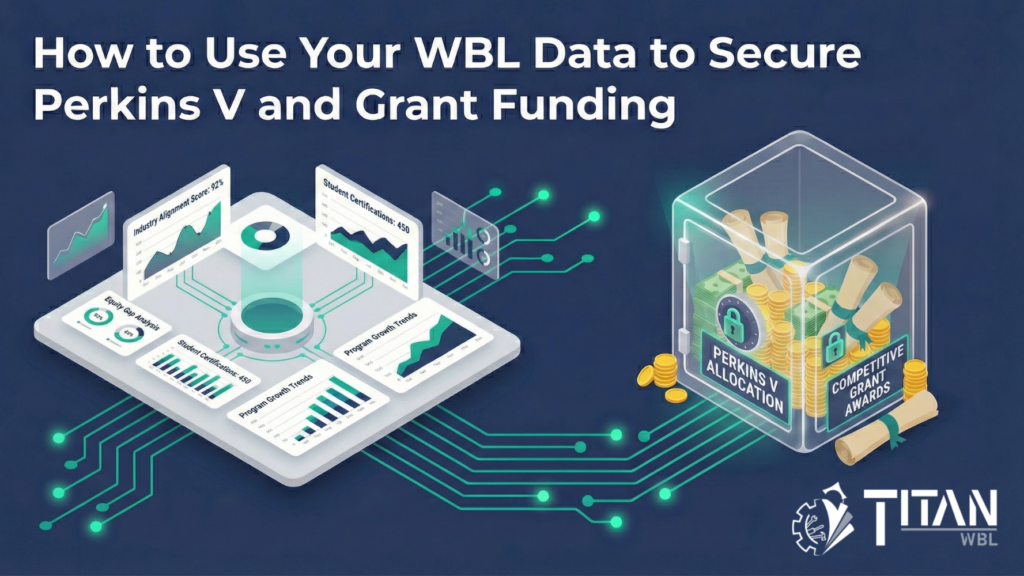
Every CTE Director knows the feeling. You have a vision for an incredible Work-Based Learning (WBL) program, but the budget doesn’t match the dream. Whether you are fighting for your district’s share of Perkins V funding or writing a narrative for a competitive state grant, one thing stands between you and the money: WBL data.
In the past, anecdotes were enough. A few photos of students at an internship or a letter from a local business owner could secure a grant. Today, that has changed. Federal and state agencies demand rigorous, quantitative evidence of student participation, skill attainment, and equitable access.
If your data is buried in spreadsheets, paper timesheets, or scattered Google Forms, you are likely leaving money on the table.
In this guide, we will explore how to transform your WBL data from a compliance headache into your most powerful fundraising asset using the TitanWBL platform.
Table of Contents
The “New” Perkins V: Why Data Matters More Than Ever
The Strengthening Career and Technical Education for the 21st Century Act (Perkins V) shifted the focus from simple enrollment numbers to program quality and labor market alignment.
Under Perkins V, funding isn’t just about how many students you have; it is about how well you serve them. This is where your WBL data becomes critical. To maximize your formula funding and avoid corrective action plans, you must provide granular data for two massive requirements:
- The Comprehensive Local Needs Assessment (CLNA)
- Performance Indicator 5S3 (Participated in Work-Based Learning)
Without a centralized system like TitanWBL Software Features, gathering this information can take weeks of manual labor. With TitanWBL, it takes minutes.
Mastering the Comprehensive Local Needs Assessment (CLNA)
The CLNA is the gatekeeper to your Perkins funds. It requires a biennial review of your CTE programs to identify gaps in performance and access.
A successful CLNA asks difficult questions:
- Are our WBL placements aligned with high-wage, in-demand industries?
- Do our industry partners reflect the regional labor market?
- Are special populations accessing high-quality internships at the same rate as their peers?
How TitanWBL Helps
Instead of guessing, you can use the TitanWBL Data Query Builder. This feature allows you to filter your WBL experiences by industry sector, hours completed, and student demographics.
You can instantly generate a report showing, for example, that while 40% of your region’s jobs are in Healthcare, only 10% of your WBL placements are in that sector. This data point is gold for your CLNA narrative. It proves a “gap” and justifies your request for funding to hire a healthcare WBL coordinator.
Pro Tip: When writing your CLNA, use visual data charts exported directly from your Titan dashboard to visually demonstrate the alignment (or misalignment) between your current programs and local workforce needs.
Crushing Indicator 5S3: Program Quality
Perkins V introduced a new indicator of program quality that states could choose to adopt: Indicator 5S3, or “Participated in Work-Based Learning.”
If your state uses this indicator, your funding relies on accurately reporting the percentage of CTE concentrators who have participated in a qualifying WBL experience.
The Spreadsheet Danger
The biggest threat to your 5S3 data is “lost hours.”
- Students forget to turn in paper timesheets.
- Hours tracked in emails don’t make it to the master spreadsheet.
- Experiences aren’t tagged correctly as “qualifying” vs. “exploratory.”
If a student completes an internship but the data isn’t recorded, you lose credit for that success.
The TitanWBL Solution
With the WBL Experience Tracker, students log hours in real-time via their mobile devices, and supervisors verify them digitally. TitanWBL acts as a “single source of truth,” ensuring that every valid hour counts toward your 5S3 denominator.
Beyond Perkins: Winning Competitive Grants
While Perkins V provides the baseline, the real opportunity for program expansion lies in competitive grants (e.g., K-12 Strong Workforce Program, Career Launch, or private foundation grants).
Grant reviewers are looking for three specific things that only robust WBL data can provide:
1. Proof of Employer Engagement
Anyone can say they “partner with local business.” Winning proposals prove it.
Using Titan’s Industry Partner Management and Advisory Board Management tools, you can pull reports detailing:
- The exact number of active industry partners.
- Total hours of mentorship provided by specific companies.
- Advisory board meeting attendance and engagement levels.
Grant Narrative Example:
- Weak: “We have good relationships with local tech companies.”
- Strong: “According to our TitanWBL data, 15 local technology partners have hosted 450 hours of student internships in the 2024-2025 school year, a 20% increase from the previous year.”
2. Evidence of Persistence
Grants want to fund programs that stick. They want to see that students don’t just try WBL once, but continue through a sequence.
Titan’s Student Groups feature allows you to track cohorts over time. You can demonstrate that students who participated in a sophomore job shadow (logged in Titan) were 3x more likely to complete a senior capstone internship. This type of longitudinal WBL data is incredibly persuasive to funders.
Proving Equitable Access for Special Populations
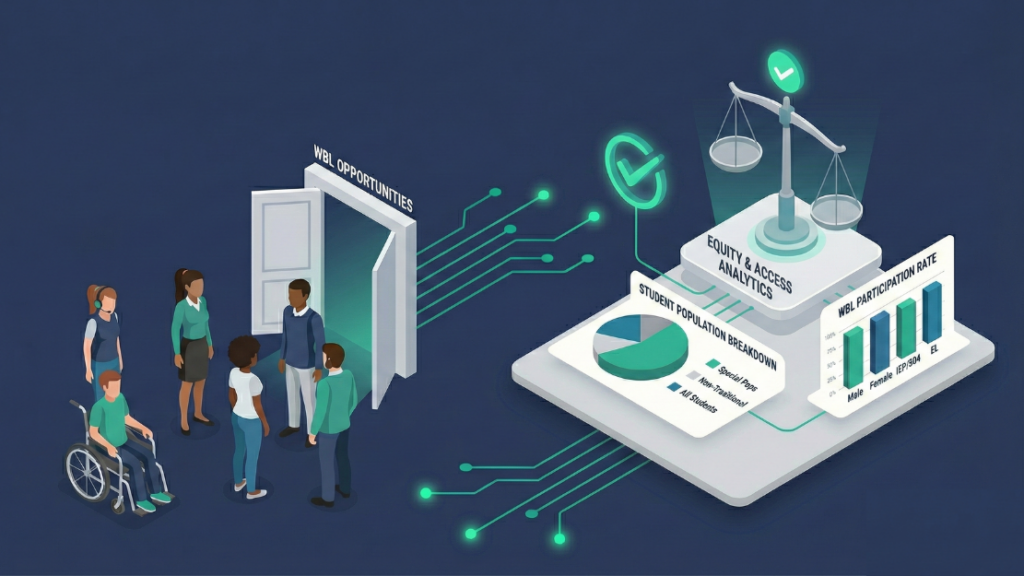
Equity is the heartbeat of modern education funding. Whether it is federal Perkins V or state-level initiatives, you must demonstrate that you are serving special populations (students with disabilities, English learners, economically disadvantaged students, non-traditional fields).
If your data is aggregate (e.g., “We had 100 interns”), you cannot prove equity. You need disaggregated data.
TitanWBL integrates with your Student Information System (SIS) via Clever. This means every WBL experience logged is automatically linked to the student’s demographic profile.
With a few clicks in the Data Explorer, you can answer:
- Are female students underrepresented in our Manufacturing internships?
- Are students with IEPs completing WBL hours at the same rate as general education students?
Identifying these gaps allows you to write grant proposals specifically targeted to close them—a strategy that has a high success rate in securing funding.
From Spreadsheets to Strategy: The TitanWBL Advantage
Data shouldn’t be a burden; it should be your battering ram to break down funding barriers. By moving from static spreadsheets to dynamic WBL data management, you shift from reactive reporting to proactive fundraising.
To recap, here is how to use your data to win:
- Centralize: Capture every hour, partner, and experience in TitanWBL.
- Analyze: Use the Query Builder to find gaps for your CLNA.
- Validate: Ensure every 5S3-qualifying experience is verified.
- Narrate: Use precise numbers to tell a compelling story in grant applications.
Don’t let your hard work go unnoticed (or unfunded). Let your data tell the story of your students’ success.
Ready to turn your WBL data into funding? Schedule a TitanWBL Demo Today and see how easy reporting can be.
