
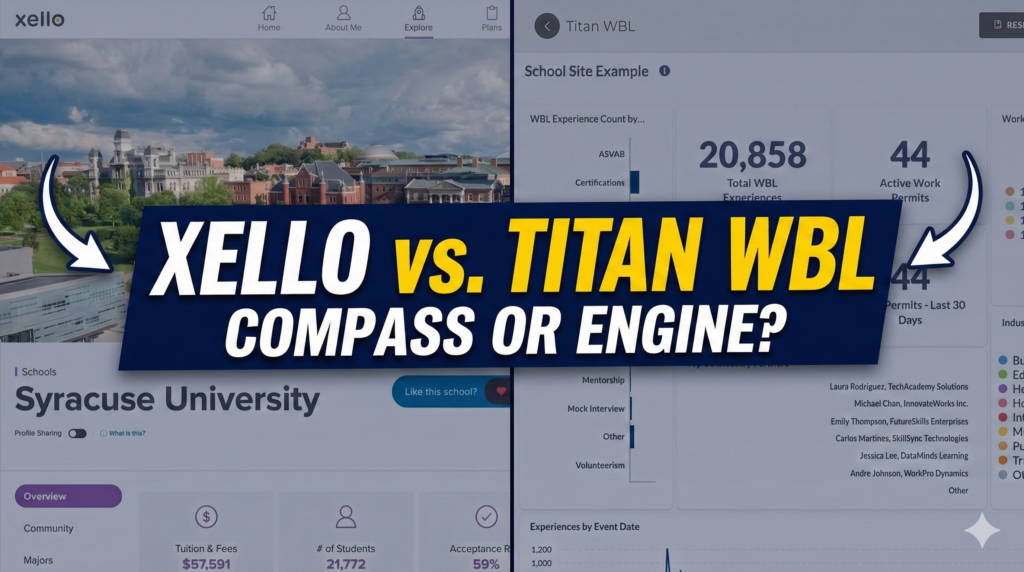
If your district is looking to modernize its student guidance systems, you are likely evaluating Xello.
Xello is one of the most widely recognized tools in the K-12 space, and for good reason. It does an excellent job of helping the general student population explore their interests and prepare for college. However, when CTE Directors try to use Xello to manage the complex operations of a Work-Based Learning (WBL) program, they often hit a wall.
“Career exploration” and running a scalable, compliant CTE program are two very different things.
As the creators of TitanWBL, we built our platform specifically to bridge the gap that tools like Xello leave behind. We designed it for administrators who need to move beyond student discovery and handle the heavy lifting of program management.
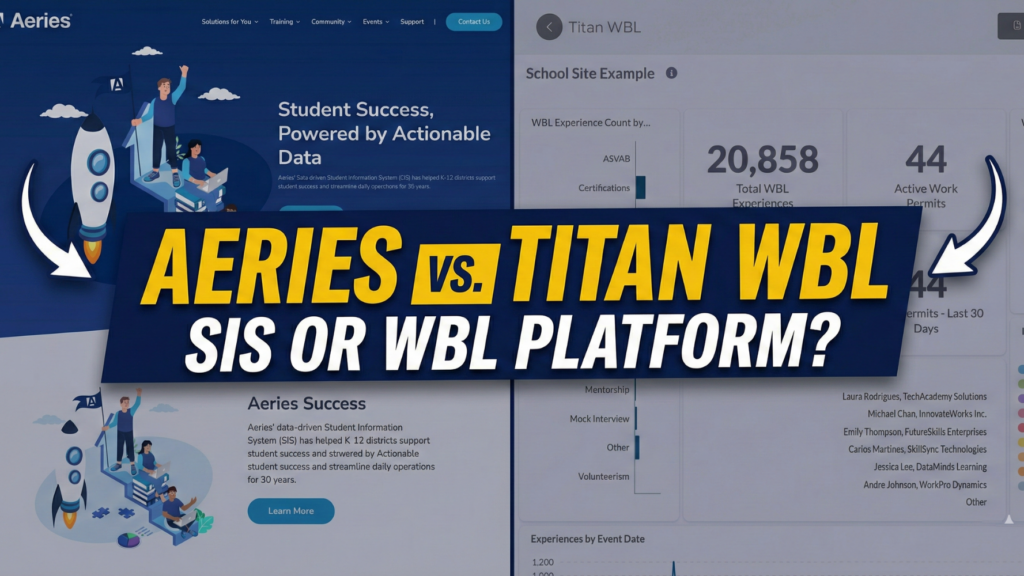
If your district is weighing its options, the core question isn’t just about features. The question is: Do you need a student compass, or do you need a district engine?
Here is a deep dive comparison into the realities of using Xello versus a specialized solution like TitanWBL.
The Fundamental Difference: Exploration vs. Operations
The primary distinction between the two platforms lies in their foundational intent.
Xello is Student-Centric Exploration (The Compass).
Xello excels at scalable, light-touch engagement for the entire student body (6th-12th grade). Its goal is to help 10,000 students take personality assessments, build basic four-year plans, and browse potential careers. It points students in a general direction.
TitanWBL is Program-Centric Management (The Engine).
TitanWBL is built for the 50 district staff members (CTE Directors, coordinators, and teachers) who need to manage the operational reality of those career pathways. Our goal is to streamline the messy, critical backend of WBL: liability forms, partner communication histories, advisory board minutes, and data disaggregation.
While Xello offers a WBL “add-on” module, it is often viewed through the lens of the student search experience. TitanWBL views WBL through the lens of district liability, operational scalability, and data compliance.
Beyond Xello: The Need for Specialized Management
When we dig deeper into the specific workflows required by unified districts, the differences between a generalist tool like Xello and a specialist engine become clear.
Here are three critical areas where unified districts often find generalist platforms insufficient.
1. True Industry Partner Relationship Management (CRM)
In Xello, “partners” are essentially treated as entries in a digital Yellow Pages—a static list for students to browse.
If you are managing a robust WBL program, you know that partners are relationships, not directory listings. You need to nurture them to prevent burnout.
TitanWBL acts as a true CRM (Customer Relationship Management) for your district. Unlike Xello, we allow you to track the entire history of the partner relationship. You can see who the primary contact is, when the district last emailed them, if they are an active member of an Advisory Board, and exactly which students they currently host.
2. The Missing Piece: Advisory Board Management
For CTE Directors, managing Advisory Boards is a massive compliance burden crucial for funding. It involves tracking rosters, scheduling meetings, recording attendance, and storing official minutes for audit purposes.
Xello does not offer dedicated tools for managing Advisory Boards. This forces districts back into spreadsheets and shared drives, creating data silos.
TitanWBL includes comprehensive Advisory Board management as a core feature. We help you maintain compliant rosters, track participation for Perkins V, and centralize meeting minutes. We ensure that when audit time comes, you aren’t scrambling through emails to prove industry engagement.
3. Data, Equity, and Perkins V Reporting
Every platform, including Xello, offers dashboards showing login statistics or popular career clusters. But CTE Directors need to answer much harder questions to secure funding and ensure operational equity.
- Are our special population students accessing high-quality internships at the same rate as their peers?
- Which specific industry sectors are under-represented in our placements this semester versus last?
Because the Xello data structure is focused on the individual student journey, aggregating program-level data for federal reporting can be challenging.
TitanWBL’s architecture is built around program data. Our advanced Query Builder allows unified districts to disaggregate data instantly by demographic, special population status, school site, and career pathway. We don’t just show you usage graphs; we give you the data needed for the Comprehensive Local Needs Assessment (CLNA).
Summary Comparison: The Depth of Features
To visualize the difference in focus, here is a breakdown of how the platforms approach key CTE and WBL functions.
| Feature Area | Xello (The Generalist) | TitanWBL (The Specialist) |
| Primary User | Students & General Counselors | CTE Directors, WBL Coordinators, Admins |
| WBL Approach | An optional module focused on student searching and requests. | Core architecture focused on the entire lifecycle: pre-work, safety, site visits, and evaluation. |
| Partner Data | A directory listing for students to browse. | A relationship management CRM for district staff to nurture partners. |
| Advisory Boards | No dedicated functionality. | Full management of rosters, meetings, attendance, and minutes. |
| Compliance | Basic tracking of hours and approvals. | Deep compliance workflows (e.g., state-specific work permit generation, safety agreement automation). |
| Reporting Focus | Student engagement and interest metrics. | Program equity, funding compliance, and Perkins V data disaggregation. |
The Verdict: Is Xello Enough?
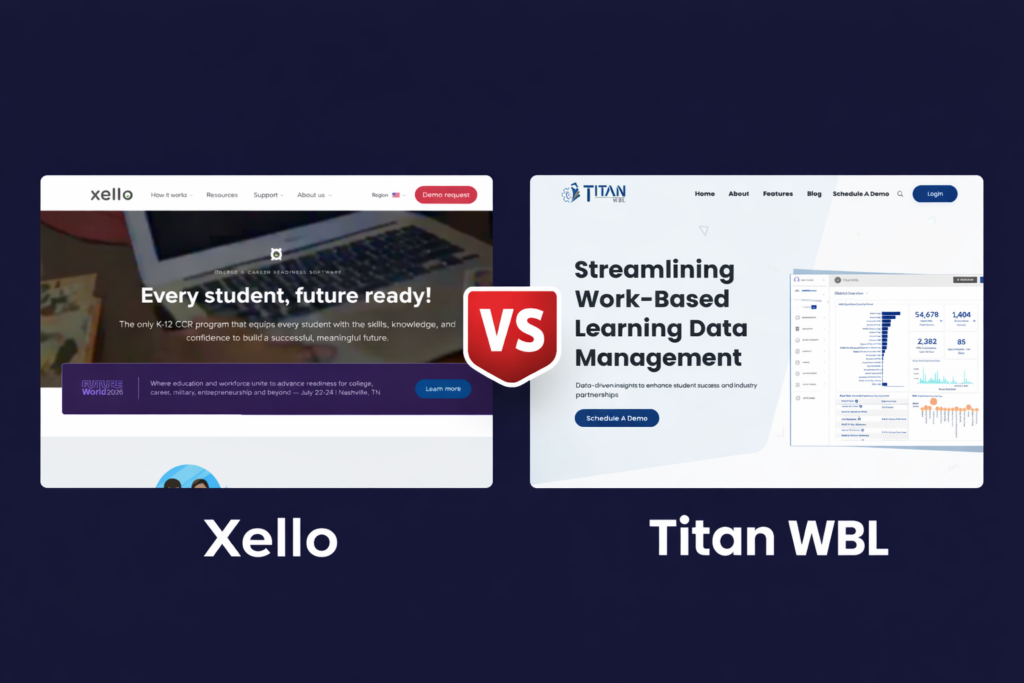
It is not uncommon for large unified districts to utilize both platforms, using Xello for broad, top-of-funnel student exploration in lower grades, and transitioning to TitanWBL to manage actual CTE pathway operations and WBL placements in high school.
However, if you are looking for a single solution to streamline your CTE processes, here is our assessment:
Stick with Xello if: Your primary goal is broad career awareness for 100% of the student population, and your WBL program is currently small, decentralized, or managed primarily at the individual school site level with low compliance overhead.
Choose TitanWBL if: You are a unified district that needs to scale work-based learning opportunities without drowning in administrative work. If you need a platform to handle partner CRMs, ensure safety compliance, centralize advisory boards, and generate deep operational data, you need the TitanWBL engine.
Stop trying to run a complex district engine with a simple student compass.
Ready to see the engine in action? Schedule a TitanWBL Demo
Sources
- TitanWBL Official Website
- Xello Official Website
- Association for Career and Technical Education (ACTE): What is CTE?
- U.S. Department of Education: Perkins V Legislation