
Why Districts Struggle to Scale Work-Based Learning Programs
The modern educational landscape is shifting rapidly toward career readiness. For CTE directors and district superintendents, the mandate is clear: successfully scale work-based learning programs to provide every student with meaningful, real-world experience. While most districts start with incredible momentum, expanding programs beyond a pilot stage often reveals a failure of infrastructure. This post explores why most districts hit an invisible, frustrating barrier when attempting to meet this goal.
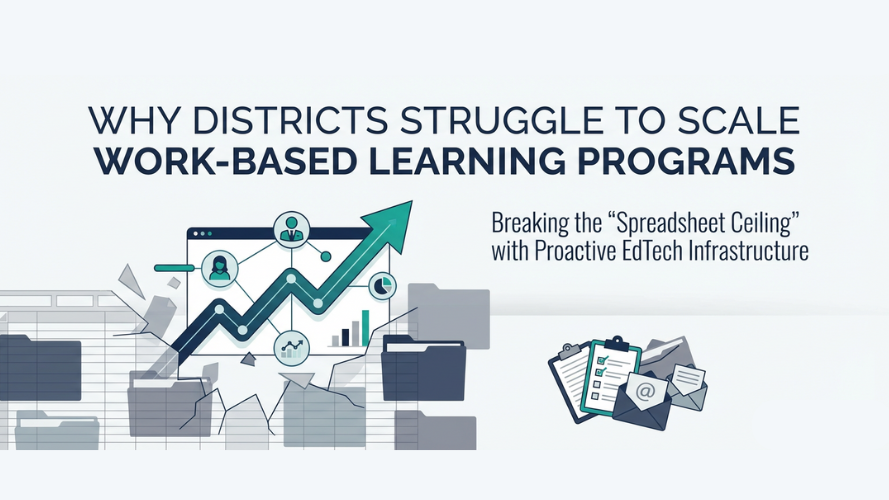
The reality is that administrative capacity, not student interest or employer demand, often determines the success of a Work-Based Learning (WBL) program. When you rely on manual tools to manage complex workflows, you inevitably hit an invisible wall: the Spreadsheet Ceiling.
To break through this capacity ceiling, leaders must transition from reactive administrative firefighting to proactive, data-driven management.
The “Spreadsheet Ceiling”: Why Manual Tracking Fails at Scale
In the early stages of a WBL program, spreadsheets seem like a logical, cost-effective tool. A coordinator opens a Google Sheet or Excel workbook and starts typing. It functions well enough for a single classroom or a small cohort.
However, spreadsheets are static tools attempting to manage dynamic, complex human relationships. Trying to scale work-based learning manually is mathematically impossible because the complexity of the data grows exponentially.
Consider the detailed data points required for a single robust placement:
- Student Data: Prerequisites, pathway alignment, schedule availability, and transportation needs.
- Employer Data: Point of contact, safety protocols, insurance validity, and mentorship capacity.
- Compliance Data: Parental permission slips, training plans, safety agreements, and liability waivers.
- Performance Data: Hours logged, competencies mastered, supervisor evaluations, and teacher feedback.
When you multiply these distinct data points by hundreds or thousands of students, a simple spreadsheet becomes a critical liability.
The Problem with Version Control and Silos
One of the most immediate issues with spreadsheet management is the “silo effect.” The health science coordinator maintains one sheet, the automotive instructor maintains another, and the district CTE director attempts to merge them manually. This fragmentation leads to data rot. If a student changes their address or an employer changes their insurance policy, that information might be updated in one sheet but not the others. The district never has a “single source of truth,” making it nearly impossible to make strategic, data-driven decisions.
The Hidden Equity Gap in Decentralized Systems
Beyond the administrative headache, decentralized tracking systems create a significant equity problem. When systems are manual and non-standardized, WBL placements often rely on the “Rolodex Method.”
In this model, opportunities are distributed based on who a specific teacher or coordinator knows. If a teacher at High School A has personal connections to a large firm, those students get premium access. Students at High School B, who may be equally qualified but lack that connection, miss out.
How Manual Systems Reinforce Gatekeeping
Without a centralized work-based learning platform, opportunities become the property of individual schools or teachers rather than district-wide assets. This unintentional gatekeeping hurts the most vulnerable student populations. To scale work-based learning equitably, you must move to a systemic model where every available internship, job shadow, and mentorship opportunity is visible in a central repository, ensuring that a student’s access to career readiness is not dependent on their zip code or which teacher they happen to have. You must implement technology to prevent the “Rolodex Method” from hindering your efforts to scale work-based learning equitably.
Compliance Nightmares: The Risk of Inaccurate Data
Funding and liability are the two critical rails that WBL programs run on. With the strengthening of Perkins V and increasingly strict state-specific CTE requirements, the demand for accurate, granular data is higher than ever.
The Liability Trap
Imagine a student is injured on a job site. The district needs to produce immediate verification of three things: the student’s signed safety training acknowledgement, the parent’s signed permission slip, and the employer’s active liability insurance certificate. If your system involves digging through a physical filing cabinet or searching months of email history, you are exposed. A digital, proactive system ensures that a student cannot even begin their placement until all compliance documents are uploaded, verified, and stored securely.
Accurate, real-time data is not only about compliance; it’s about securing the resources needed to scale work-based learning effectively.
The Funding Consequence
State and federal grants are increasingly tied to performance data. Funding bodies want proof of impact: how many students completed their hours, what skills they learned, and how those experiences connected to their coursework. If you cannot prove that 500 students completed their internships because the hours are trapped in uncollected paper timesheets, you lose funding opportunities vital to helping you scale work-based learning.
The Operational Toll on CTE Coordinators
Good WBL coordinators are hard to find. They need a rare mix of educational pedagogy, corporate sales skills, and counseling empathy. However, many districts force these highly skilled professionals to function as data entry clerks.
When a coordinator spends fifteen hours a week manually entering hours from paper timesheets or cross-referencing emails to verify signatures, that is fifteen hours they are not out in the community recruiting new partners. That is fifteen hours they are not coaching students on soft skills.
This administrative burden is the primary reason programs stagnate. A single coordinator can manually handle perhaps 50-75 high-quality placements. Beyond that, the paperwork creates a bottleneck. By automating administrative tasks, technology empowers your staff to scale work-based learning while focusing on people, not paper.
Technology as the Enabler: Transitioning to a Centralized Platform

To break through the capacity ceiling, districts must treat WBL infrastructure with the same seriousness as their Student Information System (SIS). A purpose-built work-based learning management platform, like TitanWBL, solves the scalability crisis by centralizing three critical workflows:
1. Automated Compliance and Tracking
The system automatically flags missing signatures or expiring insurance. Students log their hours via mobile apps, and supervisors verify them digitally. This creates an unshakeable audit trail without manual effort from district staff.
2. The “District-Wide” Partner Database
TitanWBL aggregates every employer partner into a single, searchable database accessible to all schools. This democratizes access and helps you confidently scale work-based learning. A student in a rural high school can see an opportunity in the city center that they otherwise would never have known existed. A purpose-built platform is the only way to successfully scale work-based learning across a large district.
3. Real-Time Insights for Leadership
Leadership dashboards provide a “mission control” view. You can see instantly which industry sectors have the most student demand, which schools have the lowest participation rates, and total hours worked across the entire district in real time.
Case Study: How Fresno Unified Scaled to 800,000+ Experiences
Fresno Unified School District (FUSD) offers a blueprint for what is possible when you combine visionary leadership with the right infrastructure. Facing a student body of over 73,000 students and high poverty rates, FUSD implemented a systemic approach supported by TitanWBL.
This successful transition allowed them to:
- Scale Massive Volume: Track over 800,000 career work-based learning experiences.
- Expand Partnerships: Manage a network of over 5,000 employer partners in a single ecosystem.
Fresno Unified offers a blueprint for how to scale work-based learning successfully and equitably. This level of scale proves that the “Spreadsheet Ceiling” is not a limit on student potential; it is purely a limit on administrative capacity.
5 Steps to Move From Reactive to Proactive WBL Management
If you recognize your district in the descriptions of reactive firefighting, here is a roadmap to begin your transformation.
- Audit Your Current “Data Silos”: Identify exactly where your WBL data lives. Fragmented data creates risk, making it impossible to confidently scale work-based learning.
- Define Your “North Star” Metrics: To properly scale work-based learning, you must move beyond measuring simple participation. Start measuring impact, such as placement equity and skill attainment.
- Centralize Your Partner Network: Create a master directory of employers accessible to all schools. This breaks down the “territorial” mindset of school-specific partnerships.
- Digitise the “Paper Chase”: Prioritize automating the biggest time-wasters for your staff, such as paper time logs and evaluation forms.
- Evaluate Dedicated WBL Software: Look for software specifically designed for CTE and WBL compliance, not general project management tools.
Conclusion: Lead With Insight, Not Guesswork
The transition to a scaled, digital ecosystem is a leadership imperative. We cannot promise students career readiness if we cannot offer the necessary experiences at scale. By removing the administrative bottleneck, you free your team to focus on guidance and relationship-building. Our goal is to help you successfully scale work-based learning across your district.
Ready to break through your district’s capacity ceiling?
Schedule a Demo with TitanWBL today and see how our platform transforms work-based learning from a logistical challenge into a strategic advantage for your entire district.
Sources
- ACTE Quality CTE Program of Study Framework. The Association for Career and Technical Education provides benchmarks for high-quality WBL programs.
- Perkins V Legislation and Resources. The U.S. Department of Education sets the national standard for CTE accountability and data requirements.
- Work-Based Learning Policy Scan. National Skills Coalition research on state-level policy growth and the economic necessity of WBL.
- Fresno Unified School District CTE Program. Reference to the successful, large-scale WBL implementation by a leading district.
