How Fresno Unified Doubled Its Work-Based Learning Data Collection in a Single Year
Introduction
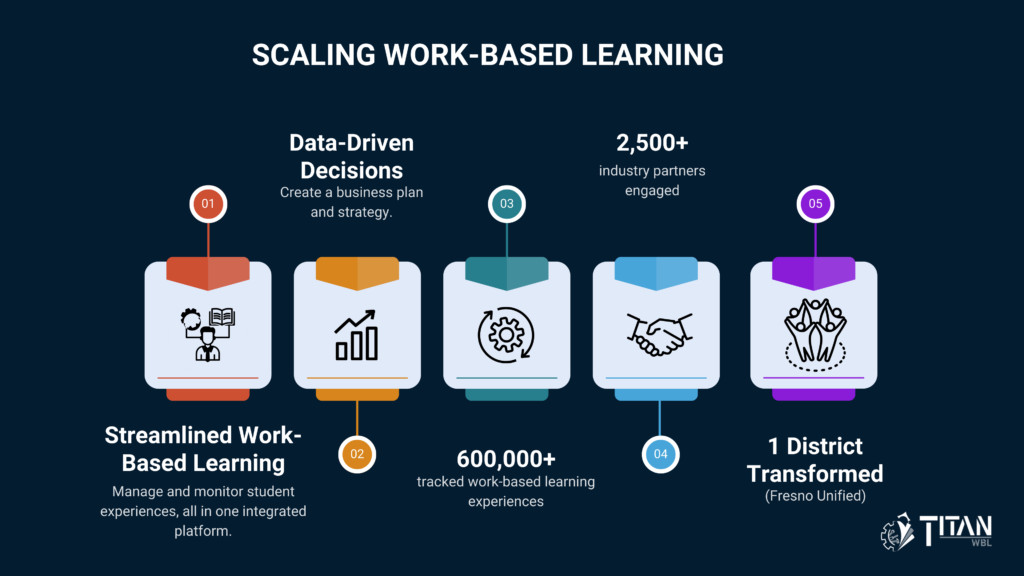
When it comes to Career and Technical Education (CTE) and Work-Based Learning (WBL), districts face a shared challenge: how to manage scale without losing quality. Fresno Unified School District (FUSD) offers a powerful case study in what is possible when the right systems are in place. By implementing TitanWBL, Fresno more than doubled its annual WBL data collection in a single year, scaled to over 800,000 Work-Based Learning experiences and 5,000+ industry partners, expanded tracking from high school CTE down into every elementary and middle school, and maintained compliance across 50+ CTE programs.
This Work-Based Learning case study shows districts that scaling is not just about doing more; it is about doing it smarter. Let’s explore how Fresno made it happen and what lessons every district can take away.
Why Scaling Work-Based Learning Is Hard
Before Fresno Unified’s transformation, Work-Based Learning coordinators everywhere shared familiar pain points:
- Data chaos: Multiple spreadsheets and one-off tools spread across schools, each with conflicting or incomplete information.
- Compliance risk: Hours spent manually cleaning data for state and federal reporting, with high potential for errors.
- Equity gaps: Difficulty tracking which students (and which schools) were missing opportunities.
- Limited partnerships: No clear system to manage industry relationships at scale.
For a district as large as Fresno, these problems multiplied. With tens of thousands of students and dozens of CTE pathways, spreadsheets were simply not sustainable.
Fresno Unified’s Turning Point: Doubling Data Collection in Year One
Fresno’s WBL data collection had bounced between beta tools, the district SIS, and Microsoft Forms before Titan. None of it scaled cleanly. In 2021-22, the last year before TitanWBL, the district logged 92,326 WBL experiences across all programs.
Then came the first year on TitanWBL.
In 2022-23, the first year on Titan, Fresno recorded 200,658 WBL experiences, more than 2x the prior year. That growth was not driven by adding pathways or hiring more staff. It was the result of finally having a system that site staff actually used. Three years in, the district has tracked over 800,000 WBL experiences on the platform.
Bringing Every School into the Program
One of the most overlooked results: Titan unlocked WBL tracking outside of high school CTE.
Before Titan, Fresno collected almost no WBL data from its elementary and middle schools. After deploying Titan, every site started reportin, and one middle school alone logged over 7,000 student experiences in a single year.
For districts that have always thought of WBL as a high-school program, this is the deeper story: when the platform is easy enough for site staff to use, WBL becomes a K-12 effort, not a CTE-only one. Equity gets measurable. Participation gets visible. And the data that drives state reporting becomes far more complete.
Built-In Readiness for Changing State Requirements
Compliance frameworks shift. California’s College and Career Indicator (CCI) dashboard is a recent example, an update added Work-Based Learning as an indicator of being career-ready, requiring a level of WBL data many districts did not have on hand.
Fresno was ready on day one.
Titan has enabled us to keep up with changing state and grant reporting requirements without having to scramble to collect something new. Like with the newest CCI dashboard update including WBL as an indicator of being career-ready, we already have all of the data they want ready to go because we’ve been using Titan to collect it this whole time.
Amber Neulinger, Data Analyst – Fresno Unified School District
That is the real value of running WBL on a purpose-built platform: when state reporting requirements change, the data is already there.
From a Static Partner List to an Active Network
Fresno already had a large database of industry partners before Titan, but it was effectively buried. After moving to Titan, that database became something staff actively use. Site teams search it, find partners aligned to their pathways, and reach out directly. The partner network has grown to 5,000+ engaged industry partners, not because anyone scrambled to add them, but because the system finally made the existing relationships visible and usable.
This is also the answer to one of WBL’s hardest problems: staff turnover. When the institutional memory of who works with which employer lives in someone’s inbox, it leaves when they do. When it lives in Titan, it stays.
A Dashboard Built for Students, Not Just Administrators
Most WBL dashboards are designed for the people running the program. Fresno’s staff-favorite goes a step further: the Student Details dashboard lets staff hand each student a printout of every WBL experience they have completed; a tangible artifact students can use for applications, portfolios, and conversations with mentors.
Combined with the role-based admin dashboards that site staff use to monitor progress, Titan turned dashboards from a back-office reporting tool into a daily-driver for the whole program.
Implementation: Fast and Scalable
Unlike many large software rollouts, Fresno’s transition was fast:
- Deployment Time: District-wide rollout in under two weeks.
- Ease of Use: Internal capability established in as little as one week.
- Adoption: Career readiness directors, coordinators, teachers, and site staff quickly adapted to role-based dashboards and reporting tools.
This rapid implementation meant Fresno could start reaping benefits almost immediately, and it is the standard onboarding pace for every TitanWBL district.
Results: 800,000+ Experiences, 5,000+ Partners
Fresno USD’s outcomes speak for themselves:
- 800,000+ Work-Based Learning experiences tracked accurately and efficiently
- 2x growth in WBL experiences captured in the first year on Titan (92,326 → 200,658)
- 5,000+ industry partners engaged and maintained at scale
- 50+ CTE programs supported with consistent data and insights
- K-12 coverage: every elementary and middle school now reports WBL activity, including 7,000+ experiences from a single middle school
With TitanWBL, I’ve gained insights that were previously buried in spreadsheets. The platform’s intuitive data dashboards and query builders have revolutionized our analysis process. Reporting work-based learning data has never been this efficient.
Amber Neulinger, Data Analyst – Fresno Unified School District
Key Features That Made the Difference
Centralized Tracking
TitanWBL eliminated data silos by consolidating student, staff, and partner information in one secure, FERPA-aligned system.
Compliance-Ready Dashboards
With automated reporting that mirrors state and federal requirements, Fresno saved staff hundreds of hours each year and stayed ahead of frameworks like Perkins V and the CCI dashboard.
K-12 Equity Insights
Dashboards give Fresno visibility into student participation by demographics and grade level, ensuring that elementary and middle school students are not invisible in the data.
Student-Facing Outputs
The Student Details dashboard turns reporting data into something students can use directly: printable summaries of every WBL experience they have completed.
Automation and Time Savings
Features like Clever SIS sync, digital work permits, and custom dashboards streamline previously manual processes.
Scalable Partnership Management
TitanWBL’s industry partner tools allowed Fresno to grow from a static partner list into an active network of 5,000+ relationships staff actually use.
Lessons for Other Districts
1. Do Not Wait Until Spreadsheets Break
Even smaller districts will eventually hit a breaking point. Transitioning early prevents crisis-driven change and, as Fresno proved, the right platform can double your data collection without adding a single staff member.
2. WBL Is K-12, Not Just CTE
If your WBL data starts at ninth grade, you are missing most of the story. Centralizing reporting lets elementary and middle schools participate in the same system.
3. Equity Requires Data
If you cannot disaggregate student participation data, you cannot ensure equity. Centralized dashboards make this possible across grade levels and demographics.
4. Compliance Should Not Be Manual
Manual compliance reporting is time-consuming and risky. Automating it ensures accuracy, frees staff for higher-value work, and means you are ready when the state changes its reporting requirements.
5. Scale Comes from Systems, Not Staff
Hiring more coordinators cannot solve inefficiency. A platform designed for Work-Based Learning scales impact without adding headcount.
The Real ROI of Work-Based Learning Software
At first glance, Work-Based Learning software may seem like an added expense. But consider:
| Factor | Without Software | With TitanWBL |
|---|---|---|
| Staff Time | Dozens of hours per month on spreadsheets | Automated, freeing staff for student support |
| Compliance | High error risk, manual formatting | Built-in dashboards ready for Perkins V, CCI, and grant reporting |
| Equity Tracking | Nearly impossible | Automated insights across demographics and grade levels |
| Scale | Breaks at high volume | Proven at 800,000+ experiences |
| Year-over-Year Growth | Capped by manual capacity | 2x growth at Fresno in the first year on Titan |
The return on investment is not just in cost savings, but also in opportunities gained for students.
Conclusion: Scaling with Confidence
Fresno Unified shows that scaling Work-Based Learning is not just possible, it is sustainable, measurable, and repeatable with the right tools. Their success with 800,000+ experiences, 5,000+ partners, and K-12 program coverage is proof that systems matter more than size.
For districts still relying on spreadsheets, this Work-Based Learning case study is a clear call to action: do not let inefficiencies and compliance risks hold you back.
Next steps
Ready to explore how your district can scale Work-Based Learning with confidence?
Schedule a demo with TitanWBL today.
References and Further Reading
- U.S. Department of Education Work-Based Learning Toolkit – Federal resource for designing and scaling high-quality Work-Based Learning programs.
- Jobs for the Future Work-Based Learning Framework – National framework outlining quality indicators and strategies for effective WBL.
- 13 Benefits of Work-Based Learning for Students and CTE Programs – Insights into how WBL boosts career readiness and student outcomes.
- The Data Trap: 5 Surprising Truths Every Higher Ed Leader Needs to Know – Why reliance on spreadsheets creates bottlenecks in education.
- Hidden Costs of Manual Attendance Tracking in Schools – A parallel case showing how manual tracking wastes staff time and introduces error.
