
The role of a Work-Based Learning Coordinator is often described as the “Swiss Army Knife” of a school district. On any given Tuesday, you are not just an educator. You are a legal liaison, a cold-call salesperson, a data analyst, and a travel agent for student internships.
As districts across the United States push for “Career Readiness for All,” the pressure on the Work-Based Learning Coordinator has reached a breaking point. We ask these individuals to scale programs from 50 students to 5,000. Yet, we often give them nothing more than a shared Google Spreadsheet and a prayer.
The question is not just about working harder. The real question is: Can a Work-Based Learning Coordinator actually scale a program without automation?
The Hidden Math of the Work-Based Learning Coordinator
To understand why scaling is “impossible” manually, we have to look at the math. A high-quality WBL experience requires several touchpoints.
- Employer Vetting: 2 to 4 hours per new partner.
- Student Matching: 1 hour per student.
- Compliance Paperwork (MOUs, Insurance): 2 hours per placement.
- Site Visits and Progress Tracking: 5 to 10 hours over the course of a semester.
If a Work-Based Learning Coordinator is managing 100 students manually, they are looking at roughly 1,500 hours of administrative labor. In a standard school year, that leaves zero room for actual student mentorship or strategic growth. This is exactly why districts struggle to scale work-based learning programs.
The Paperwork Ceiling

Every manual coordinator eventually hits the “Paperwork Ceiling.” This is the point where adding one more student to the program does not just add a little work. It threatens the compliance integrity of the entire district. When you are managing work-based learning compliance via email threads and physical folders, things get lost. In the world of Perkins V funding, “lost” means “unfunded.”
Why Hacking Your SIS Is Not the Answer
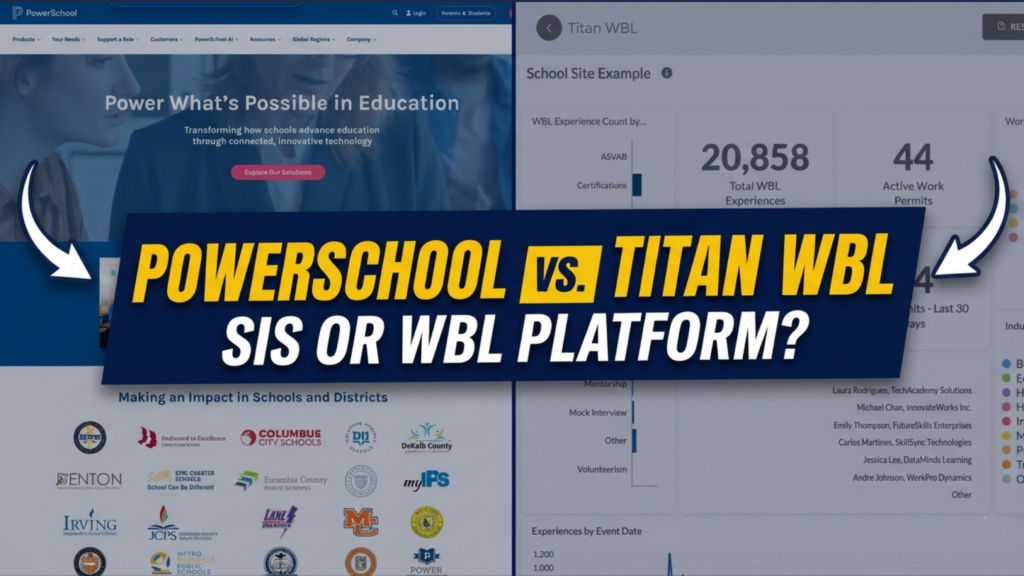
Many districts attempt to solve this by forcing their Student Information System (SIS) to track WBL. Whether you use PowerSchool or Aeries, these systems are built for attendance and grades. They are not built for the dynamic, external-facing world of industry partnerships.
A Work-Based Learning Coordinator using an SIS for WBL tracking is like a carpenter trying to drive a screw with a hammer. It technically works, but it is messy. It damages the material and it takes twice as long. Specialized platforms like TitanWBL act as the engine that handles the heavy lifting. This allows the SIS to remain the system of record without being clogged by non-academic data.
3 Pillars of an Automated WBL Coordinator Workflow
If you want to move from survival mode to growth mode, your Work-Based Learning Coordinator workflow must be built on these three automated pillars.
1. Centralized Employer Portals
The greatest time-sink for any coordinator is the back-and-forth email chain asking for openings. Automation allows employers to log into a portal, post opportunities, and track student hours directly. This shifts the data entry burden from the school staff to the industry partner.
2. Digital Compliance Chains
In 2026, there is no excuse for a wet-ink signature on an internship agreement. Digital MOUs (Memorandums of Understanding) that trigger automatic notifications to parents, students, and employers ensure that no student ever steps foot on a job site without the proper legal coverage.
3. Student-Led Documentation
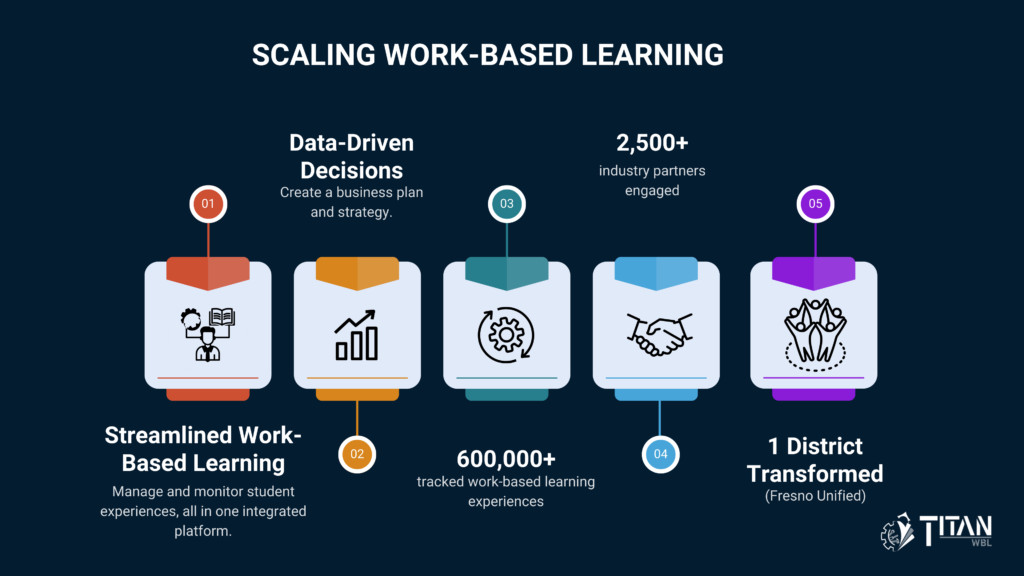
The most successful programs empower students to own their data. When a student can log their own hours via a mobile app, verified by employer sign-off, the Work-Based Learning Coordinator shifts from being a data entry clerk to a data auditor. This is a key lesson learned by districts in their first year after TitanWBL implementation.
Scaling Without Adding Staff: The 2026 Reality

Budget cuts are a reality in every district. Most boards will not approve hiring three new coordinators just because your program grew. Therefore, the only way to expand work-based learning opportunities without adding staff is through “Operational Leverage.”
Specialized software provides that leverage. It allows one Work-Based Learning Coordinator to do the work of four. It maintains high-quality oversight without requiring an 80-hour work week.
External Resource: For more on the national standards for WBL, the Association for Career and Technical Education (ACTE) provides excellent frameworks on high-quality CTE.
Conclusion: The Choice Facing Districts
We can continue to treat the Work-Based Learning Coordinator as a sacrificial lamb. This is someone who works themselves to exhaustion to keep a manual system from collapsing. Or, we can treat them as a strategic leader by giving them the tools they need to succeed.
Software automation is not about replacing the human element of WBL. It is about protecting it. By removing the administrative noise, we allow coordinators to do what they do best: build relationships that change students’ lives.
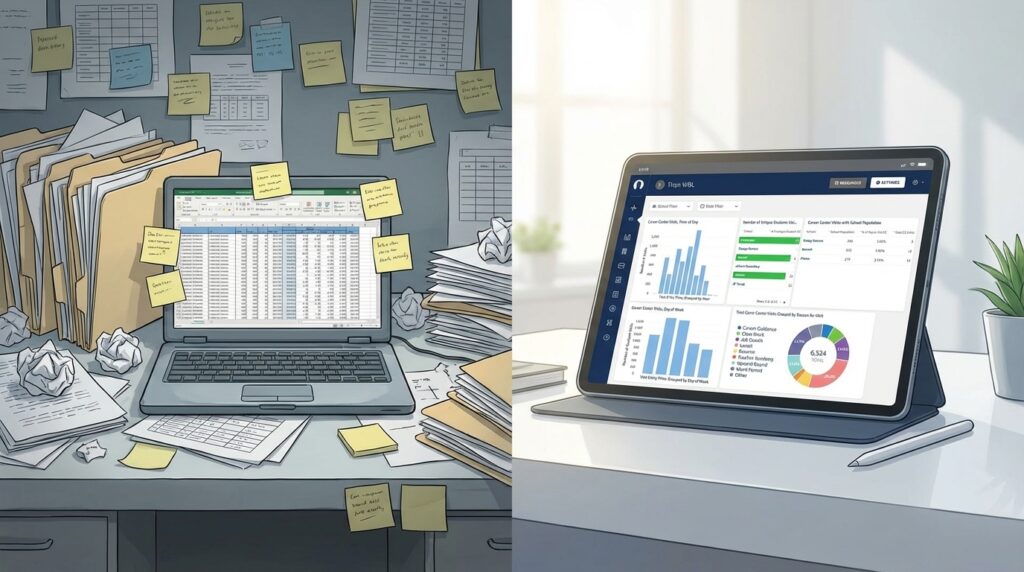
If your district is still running on spreadsheets, it is time to ask: Are we scaling, or are we just surviving?
Sources & Additional Resources
- ACTE (Association for Career and Technical Education): High-Quality CTE Framework — The national standard for managing and evaluating work-based learning excellence.
- U.S. Department of Education: Perkins V Case Studies and Data — Federal guidelines on how data reporting impacts state-level funding for secondary and postsecondary programs.
- Advance CTE: Work-Based Learning Policy Resources — A collection of state-level policies regarding employer engagement and student safety in WBL.
- NSBN (National School Boards Association): The Role of Career Technical Education in Modern Districts — Insights into how school boards view the ROI of career readiness programs.
Read More from TitanWBL
If you found this guide helpful, explore our other deep dives into scaling and managing district-wide WBL programs:
- The Big Picture: Why Districts Struggle to Scale Work-Based Learning Programs
- Staffing Solutions: 3 Ways Districts Can Expand Work-Based Learning Opportunities Without Adding Staff
- Technology Comparisons: PowerSchool vs. TitanWBL: Is Your SIS the Right Tool for WBL?
- Compliance Matters: The Compliance Risk No District Talks About in Work-Based Learning Reporting
- Real-World Success: How Fresno Unified Scaled 600,000+ WBL Experiences: Lessons for Every District