Work-Based Learning: A K-12 District Guide
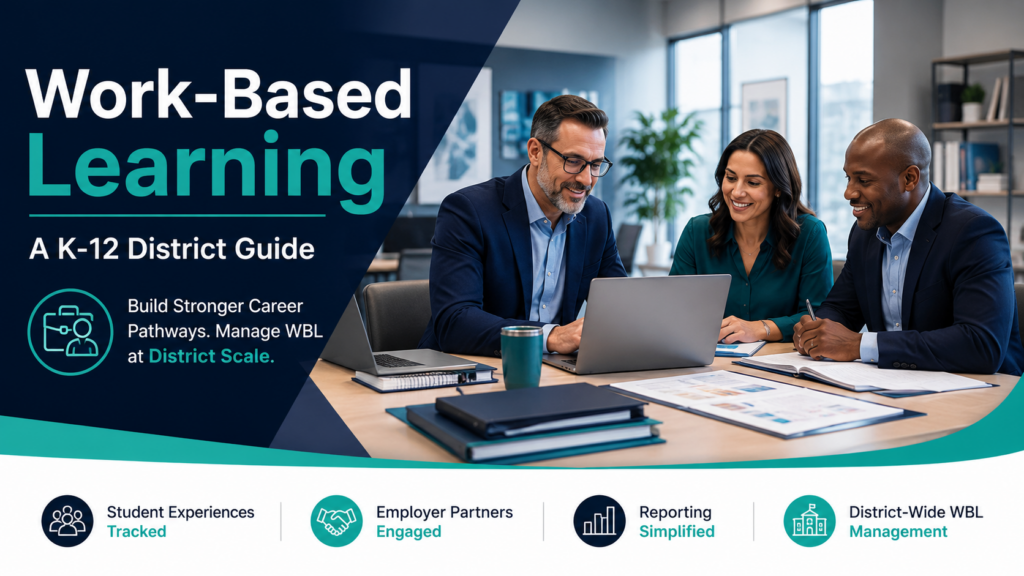
Work-Based Learning is becoming one of the most important parts of K-12 career readiness, especially for districts trying to connect classroom instruction with real career exposure, employer partnerships, internships, advisory boards, work permits, and CTE reporting.
For many districts, the challenge is no longer whether Work-Based Learning matters. The challenge is how to manage it consistently across schools, pathways, staff members, industry partners, and reporting requirements without relying on scattered spreadsheets, paper forms, disconnected tools, and manual follow-up.
That is where district-wide Work-Based Learning operations become a systems problem. A strong program needs more than individual effort. It needs shared workflows, clean data, organized partner records, student experience tracking, and reporting visibility that CTE and career readiness leaders can trust.
Quick Answer: What Is Work-Based Learning?
Work-Based Learning is an educational strategy that connects classroom learning with real-world workplace experiences. In K-12 CTE and career readiness programs, it can include internships, job shadows, guest speakers, employer site visits, advisory boards, school-based enterprises, career exploration activities, work permits, and other career-connected learning experiences.
At the district level, Work-Based Learning is not just a student activity. It is an operational system. Districts need to know which students participated, which employers were involved, which schools and pathways are active, what documentation exists, and how those experiences support reporting, equity, program quality, and career readiness goals.
A centralized platform like the TitanWBL work-based learning platform helps districts organize those workflows in one place so CTE teams can manage student experiences, employer partners, reporting, dashboards, work permits, advisory boards, internships, dual enrollment, and career readiness data with more consistency.
Table of Contents
Why Work-Based Learning Matters in K-12
Work-Based Learning matters because students need more than course completion to understand career pathways. They need opportunities to connect academic learning, technical skills, employability skills, and workplace expectations.
The U.S. Department of Education’s Office of Career, Technical, and Adult Education describes Work-Based Learning as an instructional strategy that helps prepare students for college and the workforce by connecting learning with workplace opportunities. The Perkins Collaborative Resource Network also emphasizes employer engagement, data collection, and scalable program design as important components of Work-Based Learning systems.
In practical district terms, Work-Based Learning helps students answer questions that traditional classroom instruction may not fully address:
- What does this career pathway look like in the real world?
- What skills do employers expect?
- How does my CTE program connect to local industry?
- What kind of workplace environment do I enjoy?
- What experiences can I include in my career readiness record?
For CTE directors and career readiness leaders, Work-Based Learning also supports broader district goals. It can strengthen CTE pathway relevance, deepen employer partnerships, improve program visibility, support equity conversations, and help teams document career-connected learning experiences more clearly.
But the value of Work-Based Learning depends heavily on execution. A district may have strong teachers, committed coordinators, and willing employer partners, yet still struggle to answer basic operational questions if the data lives across separate spreadsheets, email threads, forms, and school-level records.
What Work-Based Learning Includes
Work-Based Learning can include a wide range of experiences. Some are short, exploratory, and designed to expose students to careers. Others are more intensive and involve direct participation in workplace tasks, internships, or structured training.
For K-12 districts, common Work-Based Learning activities may include:
- Guest speakers: Industry professionals visit classrooms or virtual sessions to explain careers, skills, and workplace expectations.
- Career fairs: Students interact with multiple employers, colleges, training providers, or community partners.
- Workplace tours: Students visit employer sites to observe work environments and career pathways.
- Job shadows: Students observe professionals during part of a workday to understand roles and responsibilities.
- Internships: Students participate in structured workplace experiences connected to career pathways.
- Pre-apprenticeship or apprenticeship experiences: Students engage in career preparation tied to industry skills and pathways.
- School-based enterprises: Students operate or participate in business-like activities within the school setting.
- Advisory boards: Employers, educators, and community partners help align CTE programs with workforce needs.
- Work permit workflows: District staff manage student work documentation according to applicable state and local requirements.
- Employer partner engagement: CTE teams build and maintain relationships with businesses and organizations that support student experiences.
The specific activities vary by district, state, pathway, and grade level. A California district may have different state-level CTE reporting needs than a district in another state. A county office of education or ROP may manage programs across multiple schools or partner districts. A large urban district may have hundreds or thousands of employers, while a smaller district may need a leaner but still reliable system.
The common thread is that Work-Based Learning produces operational data. Every experience creates information about students, staff, employers, programs, dates, locations, documentation, participation, outcomes, and reporting categories. When that information is not organized, the program becomes harder to manage.
Why Work-Based Learning Gets Hard to Manage at Scale
Work-Based Learning becomes difficult when the program grows faster than the district’s systems. A small program can sometimes survive on spreadsheets and individual staff knowledge. A district-wide system cannot.

At scale, CTE and career readiness teams often need to coordinate across:
- Multiple high schools, middle schools, or alternative education sites
- Several CTE pathways or industry sectors
- Different staff roles and permission levels
- Employer partners with varying levels of engagement
- Student participation records across multiple experience types
- Documentation requirements for internships, work permits, or reporting
- Dashboards and reports for district leaders, site leaders, and program teams
When Work-Based Learning information is scattered, teams may face the same recurring problems every reporting cycle.
Problem 1: Student Experience Data Lives in Too Many Places
One coordinator may track internships in a spreadsheet. Another may use a form. A teacher may keep guest speaker records in a shared drive. A pathway lead may manage employer contacts in email. A district leader may need to combine all of this later for reporting.
This creates a visibility problem. District leaders may not know which students are receiving experiences, which schools are active, which programs are underrepresented, or whether employer engagement is distributed equitably across pathways.
Problem 2: Employer Partner Information Is Hard to Maintain
Employer partners are one of the most valuable assets in a Work-Based Learning program. But many districts do not have a central partner management system that shows who the partner is, what they offer, which staff member owns the relationship, which schools have worked with them, and what next steps are needed.
Without a shared system, districts risk losing partner knowledge when staff roles change. They may also duplicate outreach, miss follow-up opportunities, or fail to use existing relationships across multiple schools and pathways.
Problem 3: Reporting Becomes a Manual Burden
Work-Based Learning reporting is often the moment when scattered systems become painful. Teams may spend hours or days collecting information from schools, cleaning spreadsheets, checking missing fields, and trying to create a district-wide view.
This is especially challenging when district leaders need timely answers about participation, pathway activity, employer engagement, equity, or compliance-ready documentation.
What Centralized Work-Based Learning Management Looks Like
Centralized Work-Based Learning management means districts can organize student experiences, employer partners, program workflows, documentation, and reporting data in one shared system instead of relying on disconnected tools.
This does not mean every school loses flexibility. It means the district creates a consistent operational foundation so each school can manage Work-Based Learning in a way that still supports district visibility, data quality, and reporting needs.
A centralized Work-Based Learning system usually gives teams a clearer way to manage:
- Student participation records
- Experience types and dates
- Employer partner profiles
- Internship placements
- Advisory board activity
- Work permit workflows
- Dual enrollment tracking
- Student groups and pathway participation
- Custom dashboards and reports
- Role-based access for district and site staff
The difference is not just technical. It is operational. Instead of asking every school to send updated spreadsheets, district leaders can review program activity from a common source of information. Instead of relying on memory to know which employers support which pathway, teams can maintain a shared partner record. Instead of rebuilding reports manually, staff can work from cleaner, more structured data.
Centralized Does Not Mean One-Size-Fits-All
District-wide Work-Based Learning management should support different pathways, schools, staff roles, and reporting needs. A health science pathway may track different employer relationships than an engineering pathway. A middle school career exploration activity may look different from a high school internship. A county office of education or ROP may need visibility across multiple programs and partner districts.
The goal is not to force every experience into an identical format. The goal is to create enough structure that the district can understand what is happening, support staff, maintain data quality, and prepare for reporting.
What to Look for in a Work-Based Learning Platform
A Work-Based Learning platform should help districts manage the full operational lifecycle of WBL. That includes planning, tracking, partner management, documentation, dashboards, reporting, and continuous program improvement.
When evaluating a platform, district leaders should look beyond basic activity logging. The right system should support how CTE and career readiness teams actually work across schools, programs, and employer relationships.
1. Student Experience Tracking
Student experience tracking is the foundation of Work-Based Learning visibility. Districts need to know which students participated in which experiences, when those experiences happened, which programs or pathways they connect to, and what documentation is attached.
A strong WBL tracking platform should make it easier to see participation by school, pathway, grade level, experience type, and other district-defined categories.
2. Employer Partner Management
Employer partner management helps districts treat business and community relationships as shared strategic assets. Instead of storing partner information in personal contact lists or individual spreadsheets, teams can maintain a common record of employer engagement.
This is especially important when districts manage internships, advisory boards, workplace tours, guest speakers, and recurring partner activities across multiple CTE pathways.
3. Internship Management
Internships often require more coordination than one-time activities. Staff may need to manage student eligibility, placement information, employer contacts, documentation, schedules, and follow-up. A district-wide system should help coordinators keep those details organized.
4. Advisory Board Management
Advisory boards help CTE programs stay connected to industry needs. But advisory activity can become difficult to document if meeting notes, attendees, employer feedback, and follow-up items are scattered.
A Work-Based Learning platform can help districts maintain better visibility into advisory board participation and partner engagement over time.
5. Work Permit Workflows
In states where student work documentation is a major workflow, work permit management can become a significant administrative burden. A centralized platform can help teams organize the required data and reduce reliance on paper-heavy processes.
This should always be handled carefully. A platform can support district workflows, but it does not replace district legal, compliance, or policy review.
6. Dashboards and Reporting Tools
Dashboards help district and site leaders understand Work-Based Learning activity without waiting for a manual report. They can support questions such as:
- How many experiences have been tracked this year?
- Which schools are participating most actively?
- Which pathways have strong employer engagement?
- Which students have completed career-connected experiences?
- Where do we need additional outreach or support?
Good reporting tools do more than display numbers. They help teams make decisions, prepare for reporting, and improve program quality.
Work-Based Learning Platform vs. Spreadsheets
Many districts start with spreadsheets because they are familiar, flexible, and inexpensive. But spreadsheets were not designed to manage district-wide Work-Based Learning operations across students, partners, programs, documents, dashboards, and reporting workflows.
| Area | Spreadsheets and Forms | Centralized Work-Based Learning Platform |
|---|---|---|
| Student experience tracking | Records may be split across schools, teachers, and coordinators. | Student experiences can be tracked in a shared district-wide system. |
| Employer partner management | Partner details often live in personal files, email, or separate lists. | Employer information can be organized and shared across authorized staff. |
| Reporting | Reports often require manual collection, cleanup, and consolidation. | Dashboards and reporting workflows can reduce manual reporting burden. |
| Program visibility | District leaders may not have real-time visibility across schools and pathways. | District and site leaders can review activity from one common source. |
| Scalability | Works for small programs but becomes fragile as participation grows. | Designed to support larger, multi-school, multi-program WBL operations. |
| Staff transitions | Knowledge can leave when staff roles change. | Records and workflows can remain accessible to authorized team members. |
Work-Based Learning Reporting and Compliance-Ready Data
Work-Based Learning reporting is one of the biggest reasons districts need better systems. CTE and career readiness teams are often expected to show participation, program reach, employer engagement, student outcomes, and alignment with district or state priorities.
Reporting needs may vary by state, district, grant, pathway, and program model. For example, California districts, county offices of education, and ROPs may have state-level CTE reporting needs that differ from districts in other states. The exact requirements should always be reviewed by the district’s own leadership, legal, compliance, and program teams.
Still, the operational challenge is similar across many districts: teams need reliable data before they can report confidently.
A centralized Work-Based Learning system can support compliance-ready reporting by helping districts organize required data, maintain documentation, and prepare reports with less manual collection. This does not guarantee compliance and does not replace district review. But it can help reduce the chaos that often appears when reporting depends on disconnected spreadsheets and last-minute data collection.
For a deeper look at reporting workflows, TitanWBL also provides resources on work-based learning compliance reporting.
Why Data Quality Matters
Data quality affects more than reporting. It affects how district leaders make decisions.
If a district cannot clearly see who is participating in Work-Based Learning, it becomes harder to identify gaps. If employer partner information is incomplete, it becomes harder to expand opportunities. If experience records are inconsistent, it becomes harder to show program growth or advocate for resources.
Strong data helps leaders answer practical questions:
- Are all students getting access to career-connected learning opportunities?
- Which schools need additional employer relationships?
- Which pathways are producing the most student experiences?
- Where are staff spending the most manual time?
- What evidence can we use to support program improvement?
TitanWBL is an all-in-one Work-Based Learning platform for K-12 school districts. It helps districts centralize, track, manage, and report on Work-Based Learning programs such as internships, guest speakers, advisory boards, work permits, dual enrollment, student groups, employer partnerships, and career-connected learning experiences.
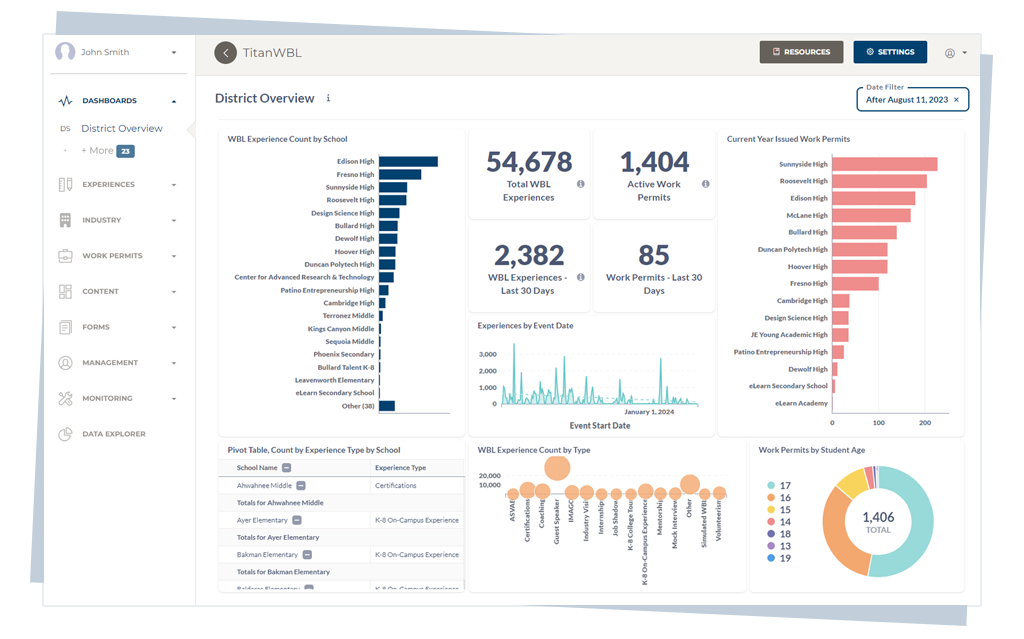
The platform is designed for the operational reality of CTE and career readiness teams. Instead of treating Work-Based Learning as a single activity, TitanWBL supports the broader infrastructure districts need to manage WBL at scale.
Core platform areas include:
- WBL experience tracking
- Internship management
- Industry partner management
- Advisory board management
- Work permit workflows
- Dual enrollment tracking
- Student groups management
- Data dashboards and reporting tools
- Role-based access and permissions
- Clever SIS sync
TitanWBL has been proven at Fresno Unified School District, where it has tracked 800,000+ work-based learning experiences in the past three years, helped engage 5,000+ industry partners, supported 50+ CTE programs, and been deployed district-wide in under 2 weeks. Districts can read more in the Fresno Unified work-based learning case study.
These proof points matter because Work-Based Learning success depends on more than software access. Districts need a system that can support real program volume, real reporting needs, and real staff workflows.
Designed With K-12 Data Privacy Needs in Mind
TitanWBL is designed to support FERPA-aligned student data privacy practices. TitanWBL works with each organization under appropriate agreements and uses student information only to provide authorized educational services requested by the district or organization.
The platform follows a data-minimization approach, limiting student information stored in the platform to what is needed to support Work-Based Learning tracking, reporting, and program management.
This language is important. TitanWBL does not replace district legal review, policy review, or compliance decision-making. Instead, it supports district workflows with K-12 data privacy needs in mind.
When Should a District Move Beyond Spreadsheets?
A district should consider moving beyond spreadsheets when Work-Based Learning becomes too important, too distributed, or too complex to manage manually.
Common signs include:
- Staff spend too much time collecting WBL data from schools.
- Employer partner information is incomplete or duplicated.
- District leaders cannot easily see program activity across pathways.
- Reporting requires manual cleanup every cycle.
- Student experience records are inconsistent across sites.
- Internship or work permit workflows are difficult to monitor.
- Staff transitions create knowledge gaps.
- Program growth is limited by administrative burden.
At that point, the question is not whether spreadsheets are useful. They are. The question is whether spreadsheets are still the right foundation for district-wide Work-Based Learning management.
For many districts, the answer eventually becomes no.
How Work-Based Learning Supports Career Readiness
Career readiness is not just about knowing career vocabulary. It is about giving students meaningful exposure to career pathways, workplace expectations, employability skills, and real opportunities to apply learning.

Work-Based Learning supports career readiness by helping students connect CTE coursework to the world outside school. A student in a health science pathway may hear from healthcare professionals, visit a clinical environment, complete an internship, or document related career-connected experiences. A student in an engineering pathway may participate in employer-led projects, advisory board activities, or workplace tours.
For district leaders, this creates an important opportunity. Work-Based Learning can become a measurable part of the district’s career readiness strategy. But only if the district can track it.
Without reliable tracking, career readiness work may happen without clear visibility. With centralized WBL tracking, districts can better understand participation, program reach, and pathway engagement.
Questions District Leaders Should Ask About Work-Based Learning Operations
Before choosing a system or improving an existing process, district leaders should clarify what they need Work-Based Learning operations to support.
- Which WBL experiences do we need to track across the district?
- How do we define each experience type?
- Which staff members enter, review, or approve WBL data?
- How do we manage employer partner relationships?
- How do we track internships, work permits, advisory boards, and guest speakers?
- Which reports do district leaders, site leaders, and state reporting teams need?
- How do we protect student information and manage role-based access?
- How do we avoid rebuilding reports manually every year?
- How do we use data to improve access and program quality?
These questions help shift the conversation from isolated activities to district-wide infrastructure.
Build a More Organized Work-Based Learning System
Work-Based Learning is too important to manage through scattered spreadsheets, disconnected forms, and manual reporting cycles forever.
If your district is trying to centralize WBL tracking, improve employer partner management, organize internships, support reporting workflows, or get better visibility across CTE programs, TitanWBL can help.
You can schedule a TitanWBL demo to see how the platform supports district-wide Work-Based Learning operations for K-12 CTE and career readiness teams.
Work-Based Learning FAQ
What is Work-Based Learning in K-12 education?
Work-Based Learning is an educational strategy that connects classroom instruction with workplace experiences. In K-12, it can include guest speakers, workplace tours, job shadows, internships, advisory boards, work permits, school-based enterprises, and other career-connected learning activities.
Why is Work-Based Learning important for CTE programs?
Work-Based Learning helps CTE students connect technical coursework with real career pathways. It also helps districts strengthen employer partnerships, document student experiences, support career readiness goals, and improve program visibility.
What is a Work-Based Learning platform?
A Work-Based Learning platform is software that helps districts track, manage, and report on WBL experiences. It can support student experience tracking, employer partner management, internship coordination, advisory board workflows, work permits, dashboards, and reporting tools.
Can Work-Based Learning be managed with spreadsheets?
Small programs may start with spreadsheets, but spreadsheets often become difficult to manage at district scale. As Work-Based Learning grows across schools, pathways, employers, and reporting needs, a centralized platform can provide better visibility and reduce manual work.
How does Work-Based Learning support career readiness?
Work-Based Learning supports career readiness by helping students explore careers, build employability skills, apply classroom learning, interact with employers, and document real career-connected experiences.
Does TitanWBL guarantee compliance?
No. TitanWBL does not guarantee compliance and does not replace district legal, compliance, or policy review. TitanWBL can support compliance-ready reporting by helping districts centralize documentation, organize required data, and manage Work-Based Learning workflows more consistently.
Is TitanWBL only for California districts?
No. TitanWBL is useful for K-12 districts across the United States. California, Fresno Unified School District, county offices of education, and ROPs are relevant examples, but the platform is designed for district-wide Work-Based Learning operations broadly.
How can a district evaluate its Work-Based Learning system?
Districts can start by reviewing how they currently track student experiences, employer partners, internships, advisory boards, work permits, and reporting data. If key information is scattered across spreadsheets, forms, and email threads, it may be time to consider a centralized WBL management platform.
Conclusion
Work-Based Learning is one of the most practical ways K-12 districts can connect CTE, career readiness, employer partnerships, and student opportunity. But as programs grow, the operational demands grow too.
Districts need more than good intentions and individual effort. They need systems that help staff track experiences, manage partners, support reporting, protect student information, and understand what is happening across schools and pathways.
A centralized Work-Based Learning platform gives districts the infrastructure to manage WBL at scale. For teams that are ready to move beyond scattered spreadsheets and manual reporting, TitanWBL provides a district-wide system built around the workflows CTE and career readiness leaders manage every day.
To see how TitanWBL can support your district’s Work-Based Learning operations, schedule a TitanWBL demo.
Sources