AI in CTE: Why Districts Need Better Work-Based Learning Data First

AI in CTE is quickly becoming one of the most important conversations in career readiness. District leaders are asking how artificial intelligence could help CTE teams summarize employer evaluations, identify students who may need more support, recommend better employer matches, and reduce the manual work that often slows down Work-Based Learning programs.
Those possibilities are real. But they all depend on one thing that many districts are still trying to solve: accurate, centralized, usable Work-Based Learning data.
AI cannot summarize evaluations that were never collected. It cannot identify participation gaps if student experiences live in separate spreadsheets. It cannot recommend stronger employer matches if partner records are buried in emails, forms, and staff memory. Before AI in CTE can actually help districts, CTE leaders need a stronger data foundation.
That is why the future of AI in CTE is not only about algorithms. It is about Work-Based Learning data, district reporting workflows, student experience tracking, employer partner management, and the systems districts use every day to manage career-connected learning at scale.
Quick Answer: Why Does AI in CTE Need Better Work-Based Learning Data?
AI in CTE needs better Work-Based Learning data because AI tools depend on accurate inputs. If a district does not consistently collect student participation, employer feedback, internship details, advisory board activity, work permits, dual enrollment records, and career-connected learning outcomes in one place, AI will have limited information to analyze.
For CTE leaders, the practical takeaway is simple: districts should not think of AI as a replacement for strong WBL operations. AI should be layered on top of a reliable district-wide system for Work-Based Learning management.
That is where a centralized platform such as the TitanWBL work-based learning platform becomes foundational. TitanWBL helps districts move away from scattered spreadsheets and disconnected systems so career readiness teams can track, manage, and report Work-Based Learning activity more consistently.
Table of Contents
Why AI in CTE Is Getting So Much Attention
AI in CTE is getting attention because career readiness teams manage a large amount of operational information. A CTE director may need to understand which students completed internships, which employers hosted students, which pathways need more partners, which schools are underreporting experiences, and which students may be missing access to career-connected learning.
Those are not simple questions. They often require data from multiple people, schools, programs, and systems.
At the same time, artificial intelligence is becoming part of the broader education technology conversation. The U.S. Department of Education has described AI as a shift from simply capturing data to detecting patterns in data and supporting automated decisions in education settings. That matters for CTE because Work-Based Learning programs generate patterns that districts often struggle to see manually.
For example, a district may have thousands of student experiences across internships, guest speakers, career fairs, advisory boards, work permits, dual enrollment, job shadows, and employer site visits. Those records may contain valuable signals about student interests, employer capacity, pathway strength, and equity gaps.
AI in CTE could eventually help districts make sense of those signals faster. But only if the data exists, is accurate, and is connected to the right student, pathway, school, employer, and outcome records.
What AI Could Help CTE Teams Do

AI in CTE should not be treated as magic. It is more useful to think about specific workflows where AI could support CTE and Work-Based Learning teams.
1. Summarize employer evaluations
Employer evaluations often contain valuable feedback about student professionalism, communication, attendance, technical skills, and workplace readiness. In many districts, those evaluations are collected through forms, emails, paper documents, or separate survey tools.
If the data is centralized, AI could help summarize patterns across evaluations. A district might ask:
- What strengths are employers consistently seeing in students?
- What workplace skills need more attention across pathways?
- Which internship sites are producing the strongest student feedback?
- Which employers need additional support or clearer expectations?
Without centralized evaluation data, however, AI has little to summarize. The tool cannot analyze feedback that lives across disconnected files or was never captured in a consistent format.
2. Identify students who may need more support
AI in CTE may also help career readiness teams identify students who are at risk of missing meaningful Work-Based Learning opportunities. That could include students who have not completed any career-connected experiences, students who participated in awareness activities but never moved into deeper experiences, or students in pathways with limited employer engagement.
This type of student support requires clean participation data. A district needs to know which students participated, what they participated in, when the experience happened, which pathway it connected to, and whether the experience met district or state reporting criteria.
If the data is incomplete, AI may overlook students who need support or flag students incorrectly. Better WBL data gives district teams a more trustworthy starting point for analysis.
3. Recommend stronger employer matches
Employer matching is one of the most promising possibilities for AI in CTE. In theory, AI could help suggest employer partners based on student interests, pathway alignment, location, prior engagement history, industry sector, required skills, and available opportunities.
But employer matching depends on employer partner management. If partner records only live in a coordinator’s inbox, a static spreadsheet, or the memory of one staff member, AI cannot make useful recommendations.
Districts need organized partner records that show who the employer is, which pathways they support, what types of experiences they offer, which schools they have worked with, and what follow-up has already happened.
This is why AI in CTE starts with partner data, not just student data.
4. Reduce manual reporting work
Many CTE teams spend too much time cleaning spreadsheets, reconciling data, checking for missing fields, and preparing reports. AI may eventually help staff draft summaries, detect missing information, or create cleaner narratives for reports and board updates.
But districts should be careful. AI should not become a layer that hides poor data quality. If the underlying data is messy, AI-generated summaries may be incomplete, misleading, or difficult to verify.
The better path is to improve the data collection workflow first. Then AI can support reporting instead of compensating for a broken process.
The Data Problem Districts Need to Solve First
The biggest challenge with AI in CTE is not whether AI can produce an answer. The bigger challenge is whether the answer is based on complete, accurate, district-wide data.
Many districts still manage Work-Based Learning through a patchwork of spreadsheets, paper forms, shared drives, SIS exports, survey tools, email threads, and individual staff records. That may work when programs are small, but it becomes difficult to manage at district scale.
For example, one high school may track guest speakers in a spreadsheet. Another may track internships through a Google Form. A coordinator may maintain employer contacts in a personal spreadsheet. A CTE director may receive final numbers only at the end of the year. A district analyst may have to clean everything manually before reporting.
In that environment, AI in CTE is limited. The problem is not the AI tool. The problem is that the data foundation is not strong enough.
Common WBL data problems
- Incomplete participation records: Some experiences are tracked, while others are missed.
- Inconsistent definitions: Schools may define or categorize WBL activities differently.
- Disconnected employer data: Partner records may not connect to pathways, schools, or student experiences.
- Manual reporting burden: Staff spend time cleaning and combining data instead of supporting students.
- Limited equity visibility: Districts may struggle to see which student groups, grade levels, schools, or pathways are underrepresented.
- Staff turnover risk: Important partner history may leave when a coordinator changes roles.
These issues matter today, even without AI. They matter even more when a district wants to use AI responsibly.
Why Work-Based Learning Data Is Different from Classroom Data
Work-Based Learning data is different because it often happens outside the normal classroom workflow. A learning management system may capture assignments, grades, course content, and student submissions. A student information system may capture enrollment, attendance, schedules, and demographics.
But Work-Based Learning is operationally different. It connects students, educators, employers, worksites, experiences, permissions, evaluations, pathway requirements, and reporting needs.
That is why districts often need a purpose-built WBL tracking platform rather than trying to force Work-Based Learning into systems designed for other jobs.
| Data Type | Typical System | Why It Matters for AI in CTE |
|---|---|---|
| Course enrollment and schedules | Student information system | Helpful context, but not enough to understand career-connected experiences. |
| Assignments and classroom activity | Learning management system | Useful for instruction, but not built to manage employer relationships or WBL documentation. |
| Internships, job shadows, guest speakers, work permits, and advisory boards | Work-Based Learning platform | Essential for understanding student career readiness participation and employer engagement. |
| Employer contacts, engagement history, and pathway alignment | Partner management workflow | Needed before AI can recommend employer matches or identify partner gaps. |
| Evaluations, reflections, and outcomes | WBL data collection workflow | Needed before AI can summarize feedback or detect patterns in student readiness. |
This is also why articles comparing classroom systems with WBL operations matter. A district may already have an LMS, but that does not mean it has the infrastructure to manage Work-Based Learning. For more context, TitanWBL has covered the difference between Canvas LMS and WBL teams, as well as the difference between SIS-centered workflows and a dedicated WBL platform in the PowerSchool vs TitanWBL comparison.
Why Centralized WBL Management Comes Before AI
Centralized WBL management gives districts one place to collect, organize, and use Work-Based Learning data. That does not mean every district runs the same program. It means the district has a consistent system for tracking career-connected learning across schools, pathways, students, staff, and employers.
For AI in CTE to be useful, data must be:
- Complete: The system captures the experiences that matter across the district.
- Consistent: Staff use shared definitions and workflows.
- Connected: Student, school, pathway, employer, and experience records relate to each other.
- Current: Data is updated throughout the year, not only during reporting season.
- Reportable: District leaders can answer questions without rebuilding data sets manually.
- Privacy-conscious: Student data is handled through district-approved workflows and appropriate agreements.
Without those conditions, AI in CTE may create more confusion than clarity. A tool may generate a summary, but staff still have to ask whether the information is complete, whether the data was categorized correctly, and whether the answer can be trusted.
The better approach is to treat centralized WBL management as the operational foundation. AI can come later as an analysis layer. The foundation has to come first.
What Districts Should Collect Before AI Can Help
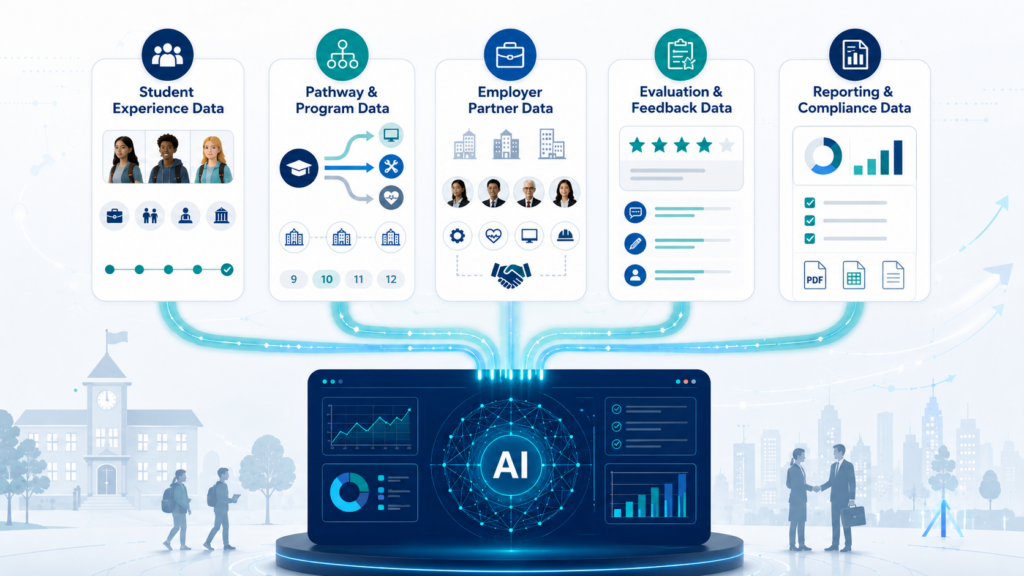
Districts do not need to collect everything before they can benefit from better data. But they do need to collect the right information consistently.
The U.S. Department of Education’s Work-Based Learning Toolkit notes that states may collect and analyze WBL participation and outcome data to understand how well experiences are meeting student and employer needs, support program improvement, and support evaluation. That same logic applies at the district level.
Student experience data
Districts should know which students participated in which Work-Based Learning activities. This includes internships, guest speakers, job shadows, workplace tours, advisory board-connected activities, work permits, career fairs, simulated work experiences, dual enrollment connections, and other career-connected learning experiences.
For AI in CTE, this is the basic participation layer. Without it, districts cannot identify gaps, summarize participation, or understand how students move through a career readiness pathway.
Pathway and program data
Every Work-Based Learning experience should connect to the appropriate CTE pathway, program, school, and grade level when relevant. This helps district leaders see which pathways have strong employer engagement and which need more support.
It also helps prevent WBL from becoming invisible outside high school CTE. Many districts now think about career readiness across K-12, including middle school exploration and early career awareness experiences.
Employer partner data
Employer partner management is a critical part of AI in CTE readiness. Districts should be able to track employer contacts, industries, pathway alignment, prior participation, site history, communication history, and the types of experiences each partner can support.
If a district wants AI to recommend employer matches, the system first needs structured employer data.
Evaluation and feedback data
Employer evaluations, student reflections, teacher notes, and coordinator feedback can all help districts understand quality. Participation counts alone do not show whether an experience was meaningful.
AI may eventually help summarize evaluation themes, but only if districts collect feedback consistently and connect it to the right experience records.
Reporting and compliance data
CTE programs operate within state, federal, grant, and local reporting expectations. Perkins V, state CTE reporting, career readiness indicators, county office requirements, and ROP reporting workflows can all place pressure on district teams.
Districts should not wait until reporting deadlines to discover that required WBL data is missing. A centralized system helps teams prepare for reporting throughout the year. For more on this operational issue, see TitanWBL’s guide to work-based learning compliance reporting.
How TitanWBL Supports AI Readiness in CTE
TitanWBL is not positioned here as a shortcut to AI. The more important point is that districts need a reliable WBL operations foundation before AI in CTE can be useful.
TitanWBL helps K-12 districts centralize Work-Based Learning management so CTE and career readiness teams can track student experiences, manage employer relationships, organize program data, and prepare for reporting in one district-wide platform.
That foundation matters because AI depends on structured, accessible, trustworthy data.
Centralized student experience tracking
TitanWBL gives districts a way to record Work-Based Learning experiences and connect them to students, schools, pathways, teachers, employers, and program areas. Instead of waiting for end-of-year spreadsheet cleanup, teams can build a more current picture of WBL participation throughout the year.
This type of student experience tracking is essential for AI in CTE because it gives future analysis a structured base.
Employer partner management
Employer relationships are one of the most valuable assets in any CTE program. They are also one of the easiest assets to lose when contact history is scattered across inboxes and individual spreadsheets.
TitanWBL helps districts centralize employer partner management so staff can better understand which partners support which pathways, what engagement has already happened, and where there may be opportunities to expand.
That matters for AI readiness because better partner records can support better future recommendations.
District reporting workflows
AI in CTE should support reporting, not replace responsible reporting workflows. TitanWBL helps districts organize WBL data so teams can prepare for state-level CTE reporting, grant reporting, local board updates, and compliance-ready documentation.
The goal is not to guarantee compliance. Districts still need to follow their own policies, legal review, and reporting requirements. The goal is to reduce the manual burden of finding, cleaning, and organizing WBL data.
Proof at district scale
TitanWBL has been proven at Fresno Unified School District, where the platform has supported large-scale Work-Based Learning tracking and reporting. According to the Fresno Unified work-based learning case study, Fresno Unified more than doubled reported WBL experiences in the first year on TitanWBL, from 92,326 to 200,658, and has tracked more than 800,000 Work-Based Learning experiences over time.
That type of district-wide scale matters for the AI conversation. AI in CTE will not be useful if it only sees a small part of the district’s WBL activity. The stronger the data foundation, the more useful future analysis can become.
AI in CTE Should Strengthen Human Decision-Making, Not Replace It
One of the most important ideas in AI in CTE is that AI should support people, not replace them. CTE directors, WBL coordinators, teachers, counselors, job developers, and employer partners understand local context in ways software cannot fully replicate.
AI may eventually help identify patterns, summarize information, and suggest next steps. But district teams should still review the information, understand the source data, and make decisions with professional judgment.
This is especially important in career readiness. A student’s pathway choice, internship placement, employer match, or support need should not be reduced to an automated recommendation. AI can help surface useful signals, but educators and district leaders should remain in the decision-making loop.
That is another reason Work-Based Learning data matters. When the data is centralized and transparent, staff can inspect the information behind a recommendation. When the data is scattered or unclear, it becomes harder to trust what AI produces.
What District Leaders Should Do Now
Districts do not need to wait for a perfect AI tool before improving their CTE data systems. The best preparation for AI in CTE is to strengthen the workflows districts already need today.
1. Audit where WBL data currently lives
Start by identifying every place Work-Based Learning data is stored. This may include spreadsheets, forms, SIS exports, LMS records, email threads, shared drives, paper documents, and individual staff files.
The goal is to understand the current data landscape before choosing what to centralize.
2. Define what counts as a WBL experience
Districts should align on consistent definitions for different types of Work-Based Learning. This includes career awareness, exploration, preparation, internships, job shadows, advisory boards, guest speakers, work permits, and other student experiences.
Clear definitions make reporting easier and make future AI analysis more reliable.
3. Connect student, pathway, and employer data
WBL data becomes more useful when records are connected. A district should be able to see which students participated, which pathway the experience supported, which employer was involved, which staff member coordinated it, and what outcome or feedback was captured.
This is the difference between activity tracking and real WBL data management.
4. Make reporting a year-round workflow
Many districts still treat reporting as an end-of-year scramble. That approach creates stress and increases the risk of missing or inaccurate data.
A better approach is to collect data as work happens. When reporting season arrives, the data is already organized.
5. Choose systems built for district operations
AI in CTE depends on infrastructure. Districts should look for systems that fit how CTE teams, WBL coordinators, county offices of education, ROPs, and school sites actually work.
A general classroom platform may not be enough. A purpose-built WBL platform can support the operational workflows that make career readiness data useful.
Where TitanWBL Fits

TitanWBL helps districts build the Work-Based Learning data foundation that makes future AI in CTE more realistic. The platform centralizes student experience tracking, employer partner management, internship workflows, advisory board management, dual enrollment tracking, work permit workflows, dashboards, and district reporting tools.
For CTE leaders, the value is not only better reporting. It is better visibility into what is happening across the district.
Which students are participating? Which schools need support? Which pathways have strong employer networks? Which partners are active? Which experiences are missing evaluation data? Which records are ready for reporting?
Those are the questions districts need to answer before AI can add value.
If your district is preparing for the future of AI in CTE, the practical first step is to centralize Work-Based Learning data today. To see how TitanWBL can support your district’s WBL operations, schedule a TitanWBL demo.
FAQ: AI in CTE and Work-Based Learning Data
What is AI in CTE?
AI in CTE refers to the use of artificial intelligence to support Career Technical Education workflows, such as analyzing student participation, summarizing employer feedback, identifying program gaps, recommending employer matches, and supporting career readiness planning.
Why does AI in CTE require better Work-Based Learning data?
AI tools need accurate and organized data to produce useful outputs. If Work-Based Learning data is incomplete, inconsistent, or scattered across spreadsheets and forms, AI may produce analysis that is incomplete or difficult to trust.
Can AI identify students who are missing Work-Based Learning opportunities?
AI may help identify students who appear to be missing WBL opportunities, but only if the district has accurate student participation data. Human review is still important because student needs, pathway context, and local circumstances require professional judgment.
Can AI help match students with employer partners?
AI may eventually help suggest employer matches based on student interests, pathway alignment, location, and partner history. But that requires centralized employer partner data, accurate student records, and clear district workflows.
Does a district need a WBL platform before using AI?
A district does not necessarily need a specific platform to discuss AI, but it does need reliable WBL data. A centralized Work-Based Learning management platform can make AI readiness more practical by organizing student experiences, employer partners, and reporting workflows in one place.
How is Work-Based Learning data different from LMS data?
LMS data usually focuses on classroom learning, assignments, course materials, and student submissions. Work-Based Learning data focuses on career-connected experiences, employer partners, internships, work permits, advisory boards, evaluations, and reporting workflows.
Is AI in CTE safe for student data?
AI in CTE must be approached carefully. Districts should consider student privacy, data minimization, transparency, bias, human review, and compliance with applicable laws and district policies. AI should not replace district legal, privacy, or compliance review.
How can TitanWBL help districts prepare for AI in CTE?
TitanWBL helps districts centralize Work-Based Learning data, manage employer partnerships, track student experiences, and prepare reporting workflows. That gives districts a stronger data foundation before adding future AI analysis or automation.
Conclusion: AI in CTE Starts with Better Data
AI in CTE has real potential. It may help districts summarize evaluations, spot participation gaps, recommend employer connections, and reduce manual reporting work. But those benefits depend on the quality of the data underneath.
Districts cannot automate what they do not track. They cannot analyze experiences that were never recorded. They cannot recommend employer matches if partner data is scattered. They cannot identify equity gaps if participation data is incomplete.
The next era of CTE may become more AI-assisted, but it will become data-driven first.
For district leaders, the strategic move is clear: centralize Work-Based Learning data now. Build the foundation for better reporting, better program visibility, stronger employer partnerships, and smarter career readiness decisions.
If your district is ready to move beyond spreadsheets and build stronger WBL operations, schedule a TitanWBL demo to see how TitanWBL can support district-wide Work-Based Learning management.
Sources