SchooLinks vs. TitanWBL: College & Career Readiness or Specialized WBL Platform?
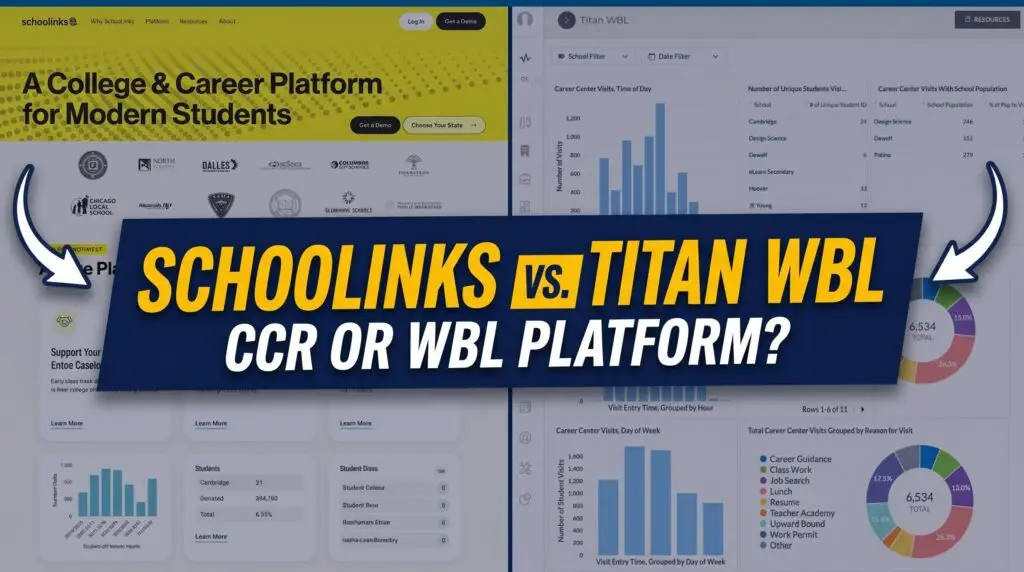
The landscape of Career Technical Education (CTE) is shifting more rapidly than ever before. We are transitioning from an era where Work-Based Learning (WBL) was an isolated, boutique offering for a handful of highly motivated seniors to a modern educational reality where it is a graduation requirement for all. As district administrators, CTE directors, and coordinators face this massive programmatic expansion, the spotlight inevitably falls on their underlying digital infrastructure.
The most common question we hear from districts looking to scale is also the most critical one. “We already have SchooLinks for our college and career readiness. Why do we need another platform?”
It is a perfectly valid question. SchooLinks is arguably a massive titan in the College and Career Readiness (CCR) market. It is robust, visually appealing, and absolutely essential for managing district-wide personality assessments, four-year academic course mapping, and university application tracking. However, when you attempt to use a generalist CCR data management tool to handle the specialized, highly dynamic, and elevated-risk logistics of Work-Based Learning, the cracks rapidly begin to show.
Just as districts evaluate student information systems in our PowerSchool vs. TitanWBL comparison, this post provides an honest, exhaustive, and detailed review of SchooLinks versus TitanWBL when it comes to managing CTE programs. We will strip away the general software marketing fluff and look closely at the raw daily workflows. We will examine exactly why relying solely on your CCR platform might be severely throttling your program’s growth and how introducing a specialized WBL platform can unlock the true potential of your career pathways.
Table of Contents
The Modern Challenge: Why Your CCR Platform Isn’t Enough for Work-Based Learning
To fully understand the comparison between SchooLinks and TitanWBL, we first need to define the fundamental problem. College and Career Readiness platforms like SchooLinks were architected from the ground up to manage the planning and discovery phases of a student’s journey. They excel at the internal, theoretical work of high school: helping a student explore career clusters, take interest surveys, and request transcripts for college admissions.
Work-Based Learning is fundamentally different because it is the execution phase. It happens outside the school walls in active, unpredictable environments. It inherently involves external actors (industry employers and community partners) who do not have access to your secure internal system. It involves fluid, unpredictable schedules that can change on a weekly basis. It involves substantial liability, safety, and compliance risks that simply do not exist when a student is sitting at a computer taking a personality quiz.
When you try to force these messy, external, and highly dynamic workflows into the broad, counselor-focused architecture of SchooLinks, you inevitably create friction. That friction manifests in the real world as countless hours of manual data entry for your coordinators, lost paper evaluations, unverified student hours, and a terrifying lack of real-time visibility into student outcomes and safety metrics.
Deep Dive: An Honest Review of SchooLinks for WBL Management
SchooLinks offers a massive suite of tools designed to cover the entire spectrum of post-secondary planning. Through its various modules, a district can theoretically find a place to store basic internship data. For a very small program managed by a single counselor who occasionally helps a few students find summer jobs, hacking a broad platform to track basic data might feel sufficient. However, for a CTE department looking to scale to hundreds or thousands of experiences, it presents significant, systemic operational bottlenecks.
The Broad Focus Trap: A Planning Tool, Not a Logistics Tool
The primary mechanism for tracking WBL in broad platforms usually involves creating generic journal entries or customizable forms. While this allows you to effectively store text data, the workflow remains entirely manual and lacks the rigorous verification required by state auditors.
To add a new internship or job shadow, the workflow is often clunky. General platforms track what a student wants to do. WBL coordinators need a system that tracks exactly what a student is doing hour by hour. This structural limitation means your highly educated, highly paid WBL coordinators are spending up to 40% of their work week trying to configure generic form builders and doing manual data entry instead of coaching students, building industry relationships, or developing curriculum. They become the primary bottleneck.
The Missing Link: Genuine Employer Engagement
Perhaps the most critical limitation of using SchooLinks exclusively for Work-Based Learning is the difficulty surrounding external employer interfaces. In general CCR platforms, the software is built for the student and the counselor. The employer is often an afterthought.
This means there is rarely a frictionless, compliant way for an employer to log in and actively manage their own partnership. If a local auto body shop owner has to navigate a massive, student-centric portal just to sign a weekly timesheet, they will quickly grow frustrated. Every single interaction, document, and evaluation often must be emailed to a school staff member, who then has the responsibility of manually entering the data into the system.
This disconnect is fatal for program scaling. You simply cannot grow and sustain a dynamic network of 500 or 1,000 business partners if you are forced to manage their engagement through complex workarounds. You need a modern system where industry partners can seamlessly manage themselves.
The Compliance Risk: Manual Coding and Liability
Reporting accurate data to the state is a high-stakes game. District funding directly depends on accuracy. Relying on generic journal entries in a broad platform usually requires staff to manually cross-reference data to ensure it aligns with strict federal Perkins V requirements.
When using generic forms, there are very few guardrails. A tired staff member or a confused student can accidentally log an hour incorrectly. The system will happily accept the input, but your state report will be flagged for an audit months later, potentially jeopardizing your funding. Furthermore, tracking highly specific technical skill attainments tied to industry credentials requires a level of granularity that broad college-prep platforms simply were not built to handle natively.
Enter TitanWBL: The Specialized Logistics Engine
If SchooLinks is your hyper-organized digital guidance office, TitanWBL is your dynamic, global logistics network. We architected TitanWBL specifically from the ground up to handle the messy, unpredictable reality of external, community-based learning.
It is crucial to understand that TitanWBL is not designed to replace SchooLinks for your counseling department. It is designed to sit seamlessly alongside it and elegantly handle the complex, multi-party workflows that a traditional CCR platform simply cannot accommodate.
The Three-Portal Ecosystem: Connecting All the Dots

TitanWBL operates fundamentally as a three-sided marketplace and communication hub. We provide dedicated, secure, and intuitive portals for the three key stakeholders:
- The Employer Portal: Employers are active, engaged users. They have their own branded dashboard where they can post new opportunities, review student applications, sign training agreements digitally, and securely upload their compliance documents. This frictionless employer engagement is what allows districts to scale their partnerships exponentially.
- The Student Portal: Students can log in via their mobile device to actively search for local internships, apply for positions with integrated resume tools, and independently log their own internship hours using secure, GPS-verified check-ins. It is an active tracking tool, not just a planning tool.
- The Educator Dashboard: Your CTE staff uses the Educator Dashboard to monitor, guide, and grow the program. They receive automated, real-time alerts if a student is consistently missing hours or if an employer evaluation scores a student poorly. They move from being data entry clerks to being strategic program directors.
Equity in Action: Moving Beyond Retrospective Compliance
Federal legislation strictly demands that we not only provide CTE opportunities but absolutely ensure they are equitable across all demographic groups. General platforms undoubtedly house rich demographic data, but combining that static data with dynamic, real-time WBL participation data is traditionally a retrospective nightmare.
Usually, a district only discovers their massive equity gaps after the school year is completely over. By then, it is too late to help that graduating class.
TitanWBL radically changes this dynamic. Our platform securely pulls core demographic data and instantly overlays it with live, up-to-the-minute WBL participation data. This synthesis creates powerful, real-time equity dashboards. A CTE Director can log in and instantly see if specific student populations are underrepresented in high-wage pathway internships, taking immediate action to recruit them. For a deeper dive into this, read our guide on using data to close the equity gap in CTE.
The Strategic Integration: How SchooLinks and TitanWBL Work Together

The strategic choice you have to make is not SchooLinks OR TitanWBL. The smart, future-proof strategy for any modern district is SchooLinks AND TitanWBL.
Your counseling department absolutely must retain their chosen CCR platform to manage the massive workload of college applications, financial aid planning, and career discovery. Simultaneously, TitanWBL acts seamlessly as the specialized system of engagement specifically for your CTE and Work-Based Learning programs.
Automated Rostering and Data Write-Back
TitanWBL connects to your district environment through standard protocols like Clever, ClassLink, or OneRoster. When a new student is entered into your primary system, their account is automatically provisioned in TitanWBL. If a student leaves the district, their access is instantly revoked.
This dual-platform approach ensures that your counselors have the perfect tool for getting students into college, and your CTE coordinators have the perfect tool for getting students into safe, compliant, and highly tracked local apprenticeships. Neither department is forced to compromise on their distinct operational requirements.
Feature Showdown: A Side-by-Side Comparison
Let us break down the specific feature differences to make this crystal clear.
| Feature Category | SchooLinks (Broad CCR Platform) | TitanWBL (Specialized WBL Platform) |
|---|---|---|
| Primary Function | College & Career Planning, Assessments | Dynamic WBL Logistics & Compliance Tracking |
| Target User | School Counselors & Students | CTE Directors, WBL Coordinators, Employers |
| Employer Access | Limited (Often requires workarounds) | Dedicated, frictionless Employer Portal |
| Hours Tracking | Basic journal entries or generic forms | GPS-Verified Mobile Check-In & Validation Chains |
| Signatures | Often relies on PDF uploads | Integrated, automated digital signatures |
| Risk Management | Manual oversight required | Automated insurance & safety expiration alerts |
| State Reporting | Broad educational reporting | Pre-mapped Perkins V & state compliance data |
Strategic ROI: The Hidden Cost of Generalist Workarounds
Using a broad, non-specialized tool for a highly regulated department incurs massive hidden costs. If your WBL coordinators spend just 15 hours a week doing manual data entry, chasing signatures, and cross-referencing compliance spreadsheets (tasks that TitanWBL automates by default), you are wasting tens of thousands of dollars in salary per year.
Furthermore, consider the severe cost of lost funding. State and federal grants are distributed based on meticulous data tracking. If your manual tracking methods accidentally miss just 50 students who actually completed all requirements for an industry credential, your district could lose out on significant grant allocations. The Advance CTE organization continually emphasizes that accurate, granular data is the only reliable way to protect and expand CTE funding.
When you factor in staff efficiency, grant maximization, and risk mitigation, a specialized platform like TitanWBL generates a positive Return on Investment often within the first year.
Conclusion: Empower Your CTE Future
Your CTE and WBL programs prepare students for the real world in ways that theoretical classroom instruction simply cannot. Do not let your digital infrastructure be the artificial ceiling on your students’ potential. The mandate is clear: we must prepare our students for the future of work by providing them with authentic, real-world experiences at scale.
You cannot build a 21st-century workforce using generic tools that were not designed for the job. While SchooLinks is an exceptional platform for college planning and broad career discovery, it was never designed to manage the complex, high-risk ecosystem of modern Work-Based Learning.
By pairing your existing systems with TitanWBL, you build a best-in-class tech stack. You empower your community partners to engage easily. You give your students a modern, digital experience that respects their agency. Most importantly, you free your educators from the burden of manual data entry so they can get back to changing lives.
Ready to see exactly how TitanWBL seamlessly integrates alongside your existing tools? Schedule a demo today and let us show you the future of Work-Based Learning.
Frequently Asked Questions (FAQ)
Does TitanWBL completely replace SchooLinks?
No. SchooLinks remains a vital tool for your counseling department to manage college applications, four-year course course planning, and broad career exploration. TitanWBL acts alongside it as the specialized logistics platform specifically for your Career and Technical Education (CTE) department to track physical internships, employer compliance, and state reporting.
How exactly does the student data get into TitanWBL?
We utilize secure, industry-standard integrations like Clever, ClassLink, or OneRoster. This completely automates the syncing of student and staff accounts every night, ensuring your CTE coordinators never have to perform double data entry.
Is TitanWBL fully compliant with student privacy laws?
Yes. TitanWBL is strictly compliant with FERPA and COPPA. It is architected with enterprise-grade security protocols to fiercely protect sensitive student data while still allowing safe, necessary communication with verified local employers.
What makes TitanWBL significantly better for our industry employers?
Unlike broad CCR platforms that focus entirely on the student and counselor, TitanWBL treats the employer as a primary user. Employers receive their own free, dedicated portal to confidently manage their company profile, evaluate students, and sign legal documents, completely eliminating the friction of endless school email chains.
How does TitanWBL help with state funding and Perkins V?
TitanWBL is purpose-built to capture the exact, granular data required by state auditors and federal Perkins V guidelines. It automatically tracks demographic disaggregation, specialized skill attainments, and total hours worked, allowing district administrators to generate audit-proof reports with a single click.
References & Industry Resources
For further reading on the standards and compliance requirements discussed in this article, please explore the following official resources:
- Perkins Collaborative Resource Network (PCRN): Official guidance from the U.S. Department of Education detailing the requirements of the Strengthening Career and Technical Education for the 21st Century Act (Perkins V).
- Advance CTE: A leading national non-profit that advocates for high-quality career and technical education and provides comprehensive research on CTE data strategies.
- Association for Career and Technical Education (ACTE): The largest national education association dedicated to the advancement of CTE professionals and program development.
- Family Educational Rights and Privacy Act (FERPA): Official guidelines ensuring the protection and privacy of student education records.
Related Posts
If you found this comparison helpful, be sure to check out our other deep dives into educational technology and CTE management:
